An Unfinished Article And Business Unfinished Forever
(2026 Preamble: I wrote a majority of this article almost exactly a year ago having been inspired by Eddie's Humble Purge series. It would've functioned as a video game version of the reading roundups people post. I kinda got stuck writing the last part of it for reasons that will hopefully become self evident, so it was left on the backburner for some time. Looking over it now I found it interesting as a time capsule of a fragment of where I was at back then. So I cleaned it up a little and added what could be construed as “author's commentary”. To differentiate between the old and new bits I will stylize my addendums in the same way as you are seeing this paragraph now.)
In light of Eddie's recent printhouse contribution I've been inspired to take a slightly more structured approach to which games I play. The most notable difference is jotting down my thoughts as soon as I finish one and cataloguing it somewhere. I've been doing this for the last few games I've played recently, and I figured it would also be fitting to write up my thoughts more clearly here for everyone to enjoy. I haven't played these games entirely in this month, but I have finished them all this month.
(Amusingly, while the article in question I was referencing is no longer recent, the current most recent Eddie article, “The Humble Purge Awards”, did also spurn me back to this unfinished article. Having held off on posting this for a while I can kind of write a dialogue with myself from last year. I didn't really end up keeping with the cataloguing habit, though I do still sort of have a backlog thingy floating in my notes. I am not adhering to it as much as I am just jotting things down so I can check them out later.)
Each of these function as sort of mini reviews. As much as I wish I could be as precise and eloquent as Jimmy McGee, I at least hope that they are interesting to read. The last time I did a big list of games type article I got the impression that it gets kinda grating after a while, so I've included links for you to jump to different sections. Feel free to break up reading this into little chunks.
(Something I touch on here that I think I still struggle with here is how I don't really have a lot of confidence in my writing. I compare myself to probably one of the best video game analysts I have ever seen and lament that my work will probably not match his quality. I think there's also an element of shame in the fact that I struggle to write at length on subjects that aren't video games, and my target of comparison here also does generally centre his work around the same topic. However, in his case he executes his ideas so well they often are profound in a way that applies to more than 'just video games'. Even a year later I don't think these feelings about myself have changed very much.)
Jump to section:
Portal 2

You play as Chell, a woman trapped indefinitely inside a deep underground scientific facility known as “Aperture Science”. You're awakened by Wheatley, a stupid, British, spherical robot who presents himself as your only ticket to escape this withering and decaying complex. Armed with a gun that can create portals you might find a way out to your freedom.
One of the all time greats, played most of it through in 2016 but never rolled credits on it for some reason. There are many games I've started but never finished, but I felt as though this one was the worst offender. I'm glad I did get back to it though because despite over a decade of technological and artistic advancements in the games industry there still isn't anything quite like it.
To analyze each aspect of this game on its own would be doing a disservice. While each pillar of this game supports this experience very strongly, I truly believe the whole is greater than the sum of its parts. While I could talk at length about each part, the point that should not go overlooked is the writing. It's rare that a game has an actually engaging cast of characters, but it's clear that Valve stands head and shoulders above the competition in terms of writing dialogue that you actually want to listen to. They knew this very well, as more often than not your reward for completing a puzzle is getting to listen to the characters react either to you or the situation at hand. These exaggerated characters in this ridiculous story is truly a treat, and becomes the ribbon that ties every aspect of this game into a nice present.
🌔🌔🌔🌔🌔
(I don't think I have much more I want to add to many of these game reviews themselves. I haven't played any of these games again so the only thing that might change is just what I remember about them one year later. It's interesting that the first game on this list connects to the idea of returning to unfinished business. The parallel here is purely coincidental but kind of poetic the way that lined up.)
Portal Stories: Mel

As great as Portal 2 was, taking a massive break halfway into the game only to finish it years later left me wanting more. Not to fear however, as Portal 2 is also known for its fully featured community created mods which often act as substitute campaigns. With new sets of levels, sometimes new mechanics, new voice acted characters, and the best of them wrap it all in an original story to boot. All of this (usually) available at the price of free! The biggest challenge mods like these would face however is a comparison to the game they derive themselves from, can a mod truly match or surpass the base Portal 2 experience?
Not quite but it is shockingly close. As a community made mod available for free I will lightly acknowledge its shortcomings and celebrate its achievements. The art and music was very good, the portal gun redesign really sets it apart as its own experience while still maintaining the visual language cultivated in the original game, I especially like the little paperclip on one of the prongs.

I also quite enjoyed the levels. That being said, I came out of this mod with a much greater appreciation of Valve's game development philosophy of extremely thorough playtesting. The level of challenge was an upward slope, which in theory is what you want but in practice it becomes pretty grueling towards the end as you do several hard puzzles in succession. There was also a spot early on where you would get softlocked if you messed a puzzle up which was quite frustrating.
The story and voice acting was fine enough. I can't really blame them for not matching Valve's excellent writing team but credit where credit is due, I didn't hate it. I actually quite liked the new antagonist and especially the final boss fight against it. It was quite creative and was definitely more fun than Portal 1's boss fight.
Despite a couple rough patches, I still found myself repeatedly coming back to this mod, which is definitely an indication of its quality. Fundamentally it filled the exact niche I wanted it to, a little more Portal 2 for me to enjoy.
⚛️⚛️⚛️
(What's intriguing here is the way that Portal Mel stacks up against Portal 2 kinda mirrors how I stack up against my own standards in terms of writing. I acknowledge the shortcomings of the mod, but I also note that it isn't realistic to expect it to be a real competitor given the difference between all of Valve software, and a couple modders. I don't really show myself that same level of consideration it seems...)
Felvidek
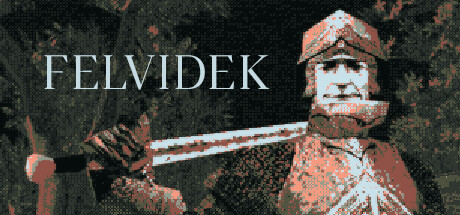
You play as Pavol, an alcoholic knight in 15th Century Slovakia. Your drunk ass is dragged around by your local Catholic priest Matej as you both are tasked by the local lord to make sure the region is free from Ottoman presence. Hopefully on the way you find your wife who walked off at some point because you were drinking too much.
I often recommend games to another printhouse reader, some of them have managed to make their way to his personal favourites. It's not often that this goes the other way, but if any game deserves to be highlighted it's this one.
I'm not typically a fan of JRPGs, but I'm not completely averse to the genre. A couple of years ago I stumbled on a quirky, short little game called Hylics with a very unique presentation. While Felvidek bears many surface level similarities to Hylics, it doesn't feel like a hollow clone in the slightest. Visually the game does a lot with a little, the limited colour palette, chunky pixels and large sprites giving it this class textbook photocopy vibe. As well as the sporadic low poly cutscene really helps set the unique visual style that this game has.
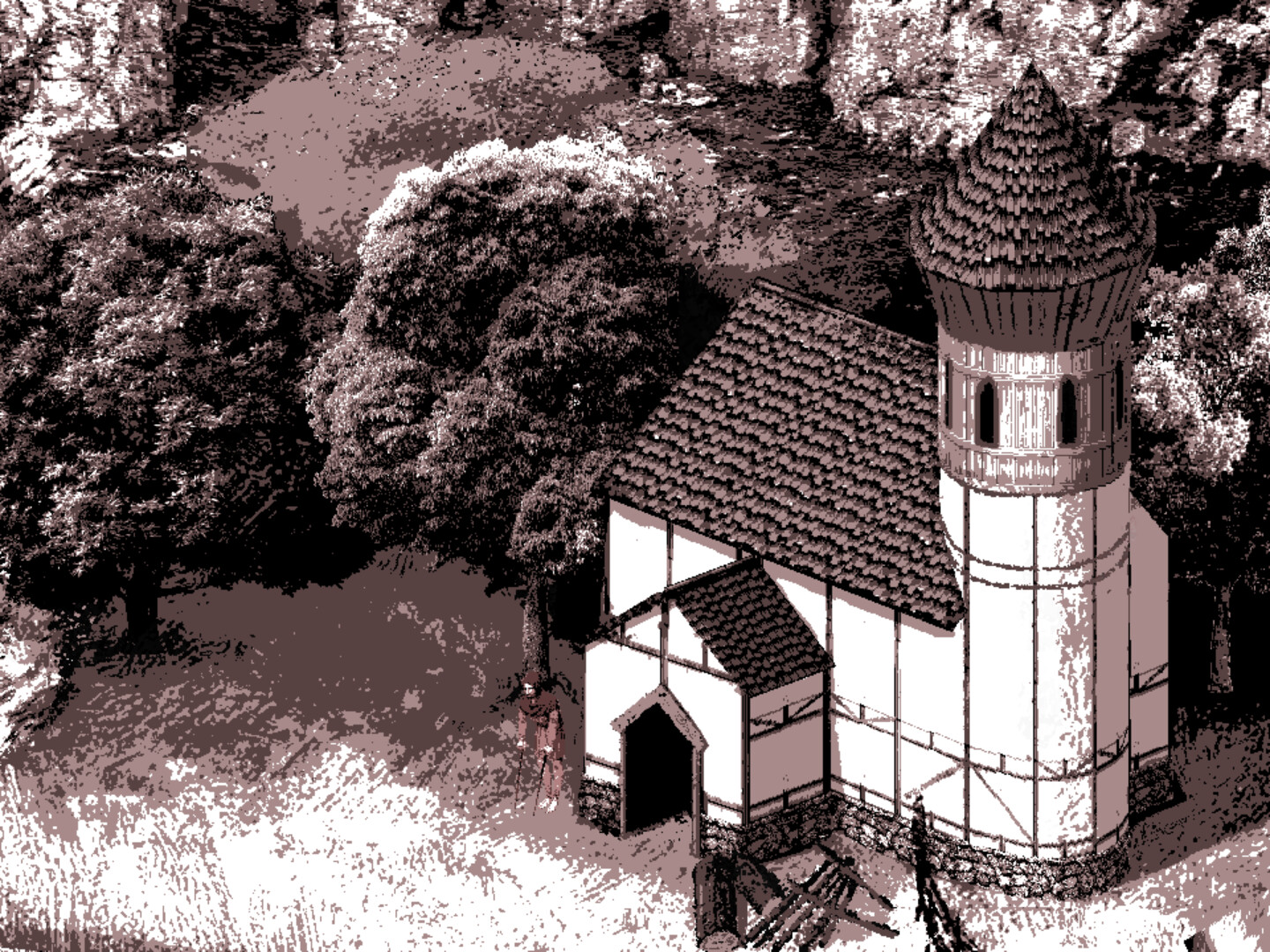
Part of my enjoyment with the game definitely comes from its intentional deviations from what might be considered the “standard JRPG formula”. Felvidek does away with the typical experience grind found in most RPGs. Your equipment is what determines your strength, and there are only a handful of upgrades. This keeps the game moving through the entire runtime which was very enjoyable. Also unlike many JRPGs which frequently last for tens, if not hundreds of hours, Felvidek is only about 4 hours long. This refreshing brevity is great for getting a nice sampling of the experience without overstaying its welcome.
(I feel the need to note that the concept of 'gear based progression' is not particularly rare in RPGs. It certainly contributes to the short runtime of the game, but it isn't necessarily true to say this is the only game that does this. I am just not very familiar with the genre.)
The biggest strength of this game however is its tone. The world of Felvidek is rather bleak, but the acknowledgement of this is placid. The characters face horrors with a grim smile and a jovial joke, because what else is one to do when faced with things beyond their comprehension? Beneath the Shakespearian prose is a genuinely very funny game that speaks of tragedy and absurdity in the same breath. The scene that best illustrates this is when an otherworldly creature crawls in through Pavol's bedroom window, stirring him from his drunken slumber. His immediate response to seeing this monstrous thing standing over him... is to wordlessly throw the closest empty bottle he has at its head.
🌞🌞🌞🌞🌞
(Looking back on this now I think the parts of this game that still stick with me are the slivers of it that references parts of my heritage. There's one joke about how Orthodox priests are able to have wives and children, which I found funny as a Coptic Orthodox christian. There's another running joke about this 'qahwa' craze tearing through this little eastern European land. Something which I immediately clocked in as the Arabic word for 'coffee'. I'll talk more about this at the end, but I have some deep regrets about not tuning into this part of my life more over the last year.)
Laika: Aged Through Blood

(TW: Violence towards children)
You play as Laika, a coyote mother who roams the sandy wastelands on her bone motorcycle and a revolver at her side. When your daughter's best friend, Poochie, is brutally murdered and crucified by the encroaching Bird army, his father, Jakob embarks on a quest for vengeance in retribution for the death of his son. You chase after him because he took your revolver to do it. So begins the spiral of blood and pain as the increasingly militant birds attempt to wipe out you and your tiny band of mammalian survivors.
What first grabbed my attention about this game was its very slick presentation. The world of Laika is beautifully rendered in this dusty yet simultaneously vibrant art style. The lovingly hand-drawn vistas and fully animated characters all come together to form a visual repertoire that is both distinct and very well executed. Interspersed throughout the game are also brief fully animated cutscenes which serve to punctuate specific moments, typically at the end of boss fights. It's clear there has been a lot of thought and care put into the look of this game, and it shows, the aesthetic identity of this game is proudly announced to your eyes, and sticks in my brain.

One I got past the eye candy, the second most prominent aspect of this game is clear. Laika bills itself as a “motorvania” and that's a fairly accurate summarization of the gameplay. When watching trailers of this game I was brought back to playing Trials Evolution on my Xbox 360. What Laika does differently however, is lessen the physics sandbox aspect of a 2d motorbike game and add in a seasoning of twitch reaction gameplay by making it a shooter. The momentum needed to clear jumps coupled with the backflip mechanic that reloads your weapons creates a sandbox where these two disparate mechanics flow beautifully together.
That being said while the game certainly has its “motor” it is somewhat lacking in the “vania”. One would expect a large world to explore gated by progression checks that you would come back later to with enhanced mobility. A typical metroidvania will present walls you can't climb up, or gaps you can't jump across prompting you to come back later when you are stronger and see what you missed. While Laika does do this, there's really only two major gates you are presented with. You pass the first one fairly early in the game, and you pass the second one right before the end. So for roughly 80% of your time with it, you are getting around the same as you were before. Riding around on your motorbike is very enjoyable, so this isn't really the biggest knock against the experience. Though, it does feel like there's something missing when you're given a grappling hook and the only thing you ever use it for is to do a sidequest.
The elements of Laika range from exceptional to middling, but the single biggest detriment I can point to is the boss fights. Laika's combat is highly lethal for the most part, all regular enemies die in one hit, as does Laika herself. That being said, it is only natural for a big hulking enemy to not die in one shot from a pistol. However, these fights are also drawn out further with phases where you can't hit the boss at all. Sometimes this is in the form of a driving section, sometimes it's in the form of you just standing there waiting for the boss to show up again for you to attack them. These things on their own are fine, but in conjunction with the fact that one mistake always sends you back to the very beginning of the fight culminates into a battle that does not test your capabilities in any way other than your patience. I feel like on some level this was known to the developers because the very final boss fight of the game was my favourite largely because its one continuous, fluid battle.
Aside from my nitpicks, the game is really quite good. The soundtrack is another major highlight. The acoustic soundscape and soft vocals contribute heavily to the feeling of this melancholic wasteland. I have caught myself on several occasions humming the vocals from certain tracks like “Trust Them” and “My Destiny”. I've never heard of the artist before but Beícoli absolutely nailed it. I also quite liked the integration of the artist into the game world itself lends a more diegetic tone to the music in the game. Especially how you collect cassette tapes to expand the soundtrack as you play the game. In fact the in-world character that the artist embodies becomes a major thematic plot point in the story of the game.
Speaking of plot, the story of this game was quite shocking, in multiple interpretations of that word. For a game that revolves around cute anthropomorphic characters I was really caught off guard by how grim the story is. Your efforts consistently prove to be futile, and the war that you fight as a single soldier is only very temporarily successful. Moreover, the game also just has really shocking moments. The odd sidequest or story beat has the possibility of just being genuinely awful, but what is one to expect when the game starts the way it did.
I didn't expect to have said as much as I did about this game, but something like this prompts you to recall it in its entirety. I respect the developer's commitment to their artistic vision, but such specialization leaves it with more of a niche appeal. The game definitely isn't for everyone, but I can certainly say that there is nothing else like it.
🦴🦴🦴🦴
(One of my main nitpicks about Laika is that despite being a game where you drive a motorbike, your character's mobility doesn't shift from where it starts for a majority of your playtime. I kinda feel that stagnation in me, I am not really a goal oriented person, but it's hard to shake the feeling that I myself haven't shifted that far from last year. Stuck having done an extra year of a Master's degree. Stuck in Kingston. Stuck having failed to achieve one of the main goals I set for myself at the beginning...)
Venba

You play as Venba, a Tamil woman who moves to Toronto in an attempt to start a new life there with her husband. Follow along as she faces the challenges of immigrating to an unfamiliar place, raises a child and most of all, cooks dinner for her family every night.
Never before have I had a game so perfectly mirror back aspects of my life that even I wasn't fully aware of. While I have never been embarrassed to be Egyptian, I can certainly say that I've had to try and balance wanting to fit in versus connecting to my own culture. The biggest barriers I've faced in trying to find this balance, is my lack of ability to speak my mother tongue. It's no secret that Arabic is a very challenging language to learn, and I've always held onto a slight frustration with my parents for not raising me with the language. The beauty of this game is that you take the perspective from the mother in this dynamic, and it's given me a lot of sympathy for my own parents in the dilemmas that they faced.
Food is a wordless language, which allows it to be expressed and understood universally. Eating a meal from my heritage is like having a conversation with my ancestors. I take great delight in being afforded this opportunity where I otherwise fail with spoken words. I've clung to it as the strongest means of interfacing with my roots. Venba is a cooking game, but in the way that food forges interpersonal connections with friends and family.
(This was all I had written about Venba, not because I didn't have more to say but because I had a lot of difficulty trying to explain the deeply resonating experience of playing this game as a second generation immigrant living in Canada. I was also doubting if anything I would've said would've made sense from an outsider's perspective. Having finished the game I was left with an overwhelming need to attempt to properly connect to my culture and ancestry by trying to mend the bridge that was never properly built in the first place, learning the Arabic language. It was going to be my new year's resolution)
(I have never done a new year's resolution before, and as you might have gathered, it was not very successful. This, in and of itself, isn't particularly bad, but there is another major event that especially twists this knife in me. In my life I never got to meet my grandfathers, they passed before I had the chance. My only remaining grandparents have been my two grandmothers. They are lovely people, but I have always struggled connecting with them primarily due to the language barrier. As a result, I was never particularly close to them. So a secret wish of mine in this new year's resolution I set for myself was to leverage that newfound knowledge to get to know them a little better.)
(They both passed this year, one not long after the other...)
(...)
(I write this in the dwindling hours of Coptic Orthodox Christmas, another fun quirk of my background I hold dear. This was the first one my family has had without them around. I don't really miss them as much as I feel like I should. The unrealized potential of what my bonds to them could have been had I learned Arabic stings more than the actual bonds that I lost. That makes me feel kinda shitty, like I don't actually care for them or something...? I don't know, it's weird.)
(Am I even gonna post this? Or will this addendum be unfinished just like so much of this past year. This article, left to fester in my obsidian notes. Perhaps it will grow like a tumour as I add more to it year on year. Why write this flavoured up image of myself and post it for my friends anyways?? Why do anything at all???)
(Like... it's not like they couldn't speak any English, one of them was decently fluent in it. Is it really worth it to play up that aspect for the sake of dramatics, even if it isn't fully true? )
(I want to be better about finishing things, and maybe that starts here with this weird ass, slightly fictional, self indulgent article...)
(I still want to learn Arabic, if for no other reason than to strengthen the bonds I have with the people who share my culture. But I will have to learn to spend the rest of my life with the regret that I didn't do it soon enough to talk to my grandmothers in our mother tongue. So I will cherish the moments that I was fortunate to get, the broken english conversations, the odd secret 20 dollar bill unbeknownst to my parents and most importantly the delicious meals we got to share.)
