Reading Roundup: The Boy Who Was Bear
February 2026
I'm still here! I've been pretty excited to keep reading and blogging for this month. This month I read 5 ebooks and 2 eaudiobooks from the Toronto Public Library, and 1 epub, totalling to 8 books.
The numbers as they stand, as of February 28th 2026
Total Reading Goal: 16/100 (+8)
Canada Reads Shortlist: 2/5 (+1) – I added A Minor Chorus by Billy-Ray Belcourt
Canada Reads Longlist: 2/10 (+1) – I added Restaurant Kid by Rachel Pham
Nonfiction Goal: 1/12 (+1) – Restaurant Kid again, since it's a memoir
TPL Reading Challenge: 6/25 (+2) – The Future of Another Timeline by Annalee Newitz, for the category “Dual Perspectives” – The God of the Woods by Liz Moore for the category “Family Saga”
The Names by Florence Knapp
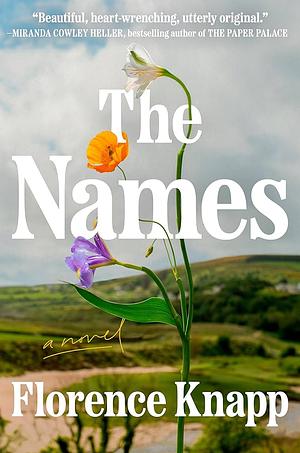
Synopsis: In the wake of a catastrophic storm, Cora sets off with her nine-year-old daughter, Maia, to register her newborn son’s birth. Her husband, Gordon, a local doctor, respected in the community but a terrifying and abusive presence at home, intends for her to name the infant after him. But when the registrar asks what she’d like to call the child, Cora hesitates…
Spanning thirty-five years, what follows are three alternate and alternating versions of Cora’s and her young son’s lives, shaped by her choice of name: Gordon, chosen by his father; Julian, chosen by his mother Cora; and Bear, chosen by his sister Maia. In richly layered prose, The Names explores the painful ripple effects of domestic abuse, the messy ties of family, and the possibilities of autonomy and healing.
My thoughts: I thought this book would be dense and pretentious, but it was actually very beautiful and moving. It was so interesting to see how different characters and events shaped the son’s lives in different ways when he was Gordon vs Julian vs Bear. It’s not quite the same as nominative determinism, but it was immediately clear that the choice of name dramatically changed the son’s (and the whole family’s) lives. (I feel like this is a bit of a click-bait sentence; in actuality, the driving force behind the different lives is how the son’s name influences his abusive father’s reaction and resulting actions; whether he accepts the name Gordon, tolerates the name Julian, or completely rejects the name Bear). One thing that I was obsessed with at the beginning of the book was trying to determine which of the lives was the “best” life. Obviously, I figured, it had to be Bear’s life; his father was completely out of the picture, and he had a happy and idyllic childhood with his mother and sister and found family of neighbours. But as you go through the story, that’s obviously not the point. While all the lives end up being very different, they each have their share of happiness and hardships, and you can see that the son aches for the relationships that he has in other lives. In the end, it’s up to the reader to determine which life was truly the best one (I think I still stand by Bear, but there’s a lot more nuance now; his adult life suffers, and he ends up dying very young, but I still can’t get over the joy and community of the perfect childhood). This really was a hauntingly beautiful book, and I would definitely recommend it.
Rating: 4/5 simple pieces of silver jewellery, hand made by you for the woman you love
The Future of Another Timeline by Annalee Newitz
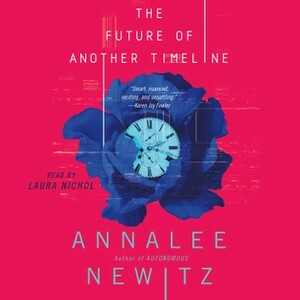
Synopsis: This book exists in a universe where time travel is a fact of life, made possible by a group of stone “machines” that have existed for tens of thousands of years. It’s in the popular culture, but mostly used by academics studying cultural geology, and can only be used to travel back in time from one’s current present. In 1992 CE, Beth is a high school in California, struggling with her difficult home life and unsure how she can continue to support her best friend Lizzie when Lizzie begins to travel down a dangerous path. In 2022 CE, Tess works as a cultural geologist during the day, traveling back in time to observe and document key moments in feminist movements. By night, she belongs to a group of activists known as the Daughters of Harriet; a group of women and non-binary people that are dedicated to changing the timeline by making “edits” in the past. When they discover a group of men known as the Comstockers (followers of Anthony Comstock, a pro-censorship, anti-women, anti-sex education activist of the early 20th century) are attempting to lock history into a decidedly misogynist edit, Tess and the DOH spring into action. But will it be enough?
My thoughts: This book is best described as “feminist queer punk rage against the machine” and honestly is not really my cup of tea. I listened to this book as an audiobook, and while I normally don’t have much criticism of the narrator, I really did not like Laura Nichol’s performance. No fault to her, but I thought her voice and overall mannerisms were super immature. I’m unsure if this was her first narration experience, but her performance felt very unpolished in a way that I’m having trouble articulating, but I feel like you would notice if I played you a sample of the audiobook. It permeated the novel and probably made me dislike the book more than if I had read it. However, I will say that it felt very punk, very true to the book, so maybe I just don’t like the book itself. Wherever I get into a situation like this, where I am disliking a very feminist book, I feel a bit guilty; is this book actually bad or am I personally just full of internalized misogyny? Did I not like this book because the feminine characters don’t subscribe to my ideas of femininity, or because the plot was not well thought out? I suspect it’s a little bit of both. Personally, I am not a very activist person; I am much more likely to go with the flow and tolerate the status quo instead of standing up for my personal beliefs; is that why I didn’t vibe with these womxn who are willing to go after what matters to them, even if they have to kill for it? Am I too afraid of breaking the rules to really appreciate what it means to kill a guy who is trying to rape your friend? I guess I don’t really know.
Rating: 2/5 tickets to a Grape Ape show
Shroud by Adrian Tchaikovsky
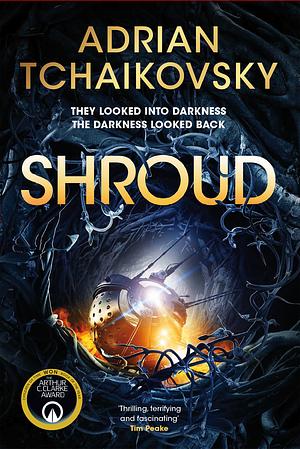
Synopsis: A commercial expedition to a distant star system discovers a pitch-black moon alive with radio activity. Its high-gravity, high-pressure, zero-oxygen environment is deadly to human life, but ripe for exploitation. They named it Shroud. Under no circumstances can a human survive Shroud’s inhospitable surface – but a catastrophic accident forces Juna Ceelander and Mai Ste Etienne to make an emergency landing in a barely adequate escape vehicle. Alone, and fighting for survival, the two women embark on a gruelling journey across land, sea and air in search of salvation. But as they travel, Juna and Mai begin to understand Shroud’s unnerving alien species. It also begins to understand them. If they escape Shroud, they’ll somehow have to explain the impossible and translate the incredible. That is, if they make it back at all . . .
My thoughts: The first part of this book was a lot of exposition setting up the space-faring hyper capitalist society. The second part of this book was unabashedly terrifying: the story of two women who are accidentally marooned on a strange moon, full of completely alien creatures. Shroud is completely deadly to humans, by virtue of a high pressure atmosphere that would crush you, a toxic atmosphere that would poison you, and a bonechilling temperature that would instantly freeze you. This book wasn’t intended to be a horror book, but it felt like I was reading one of those survival horror movies like The Shallows (2016) (the protagonist is trapped on a buoy trying to survive a great white shark attack) or Fall (2022) (the protagonists are trapped on the top of a 2000-foot radio tower when their only ladder breaks). Genuinely terrifying. As the book goes on it becomes less scary (at least to me) and more of a gruelling trek for survival. Juna and Mai have determined that the only way for them to possibly get off of Shroud is if they traverse the moon in order to reach the space elevator that was constructed on the polar opposite side of Shroud. It’s interspersed with chapters from the POV of the Shrouded, Juna’s name for the aliens that they first encounter. The Shrouded was a really interesting concept for an alien, and I thought those chapters were well done. I also thought that the juxtaposition between this literally “alien” form of life compared to the hypercaptialist megacorporation The Concern, who control all of the existing spacefaring human civilizations (here, everyone lives in a desperate attempt to be useful, knowing that if they don’t meet their quotas they’ll be unceremoniously returned to cryosleep, where they might languish for the rest of their lives). Tchaikovsky’s choice to have one of his protagonists be Juna, a jack of all trades, master of non, was also interesting. Her role aboard the spaceship was to be the social grease that kept the gears of her team running; resolving conflict and accommodating everyone. She acts as the social and moral support for Mai, the genius engineer who constructed the pod that is their only hope of survival. I appreciated that it never felt like Juna had no agency; even though she wasn’t doing the bulk of the engineering, she was definitely contributing to their overall survival, especially when you consider that the trek across Shroud took them weeks to complete. This overall feeling of agency was helped because both of the characters equally had little agency; when you’re trapped on an alien moon, you aren’t there to drive the plot forward in complicated ways; your job is to roll with the punches of an unfamiliar environment and hope that you simply don’t die. Overall, this was a really well done book, and I would definitely recommend to anyone who is looking for a sci fi saga.
Rating: 4/5 ambassadors that contain chemical messengers inside them (how was I supposed to know that you weren’t an ambassador)
The God of the Woods by Liz Moore

Synopsis: When Barbara Van Laar is discovered missing from her summer camp bunk one morning in August 1975, it triggers a panicked, terrified search. Losing a camper is a horrific tragedy under any circumstances, but Barbara isn’t just any camper; she’s the daughter of the wealthy family that owns the camp — as well as the opulent nearby estate and most of the land in sight. And this isn’t the first time a Van Laar child has disappeared in this region: Barbara’s older brother Bear also went missing fourteen years ago, never to be found. How could this have happened yet again? Out of this gripping beginning, Liz Moore weaves a richly textured drama, both emotionally nuanced and propelled by a double-barreled mystery. Chasing down the layered secrets of the Van Laar family and the community working in its shadow, Moore’s multi-threaded drama brings readers into the hearts of characters whose lives are forever changed by this eventful summer.
My thoughts: I picked up this book after Kaitlyn needed some motivation to finish her copy. Again, I was expecting it to be dense and pretentious, but I found it to be very readable. It’s a bit of a murder mystery, but not really. Instead of being mysterious, it’s about the lives of the characters who were present at the time of Barbara’s disappearance. There is a missing persons investigation, but the book doesn’t spend so much time on it that it really feels like a crime novel. Moore spends most of the time unravelling the lives of the different characters, most of which I found to be very compelling. I think that if I had picked up this book a few years ago, I probably would have found it to be boring, a “nothing ever happens book”, and would have been disappointed that it wasn’t actually a crime thriller. But at this time in my life, I enjoyed it and appreciated it for what it was. Maybe it means that I’m growing up.
Rating: 3/5 murals on bedroom walls, heartbreakingly covered up with garish pink paint
Restaurant Kid: A Memoir of Family and Belonging by Rachel Phan

Canada Reads 2026 Longlist
Synopsis: When she was three years old, Rachel Phan met her replacement. Instead of a new sibling, her parents’ time and attention were suddenly devoted entirely to their new family restaurant. For her parents—whose own families fled China during Japanese occupation and then survived bombs and starvation during the war in Vietnam—it was a dream come true. For Rachel, it was something quite different. Overnight, she became a restaurant kid, living on the periphery of her own family and trying her best to stay out of the way. In Restaurant Kid, Rachel seeks to examine the way her life has been shaped by the rigid boxes placed around her. She had to be a “good daughter,” never asking questions, always being grateful. She had to be a “real Canadian,” watching hockey and speaking English so flawlessly that her tongue has since forgotten how to contort around Cantonese tones. As the only Chinese girl at school, she had to alternate between being the sidekick, geek, or Asian fetish, depending on whose gaze was on her. Now, three decades after their restaurant first opened, Rachel's parents are cautiously talking about retirement. As an adult, Rachel’s “good daughter” role demands something new of her—and a chance to get to know her parents away from the restaurant.
My thoughts:
As someone who grew up in a very diverse city, and came of age in the 2010s, it was shocking and horrifying to hear about the racism that the author experienced as a kid growing up in the 2000s in Essex county, Ontario. She grew up in a small town that was 95% white, and the behaviours of her classmates and peers felt cartoonishly racists (not to say that they didn’t happen, but to say that the early 2000s was apparently a gross time to be a POC). Although the book mainly covers the author’s childhood, she shared some parts of her current adulthood, and it was really gratifying to see that she was able to start dealing with some of the trauma she endured from her classmates, and also see her thrive in a community where she was able to stand up for herself.
Restaurant Kid was eye opening in a lot of ways, but one specific way that I wanted to touch on was how Rachel’s childhood differentiated from my own. Growing up in the 2000s as the youngest child, she had little to no parental oversight, and was apparently constantly drinking, smoking, and having sex. I was a super boring teenager with a lot of parental oversight, and I did none of those things. In particular, Rachel focuses a lot on her sexuality and sexual experiences as a tween and teen. This topic received a lot of “page time” but didn’t seem to have a similar outsized effect on the overall story of her life. It doesn’t lead into a journey of discovering her sexuality, it doesn’t lead to any kind of medical conditions, and it doesn’t seem to have that much of an effect on her adult dating life (which to me, someone who has no expertise in this area, seemed pretty normal for a young woman in the late 2010s and early 2020s) I’m wondering if the book could have been better balanced; I was specifically shocked at the relatively little time that Rachel spent discussing her depression and suicidal ideation; as someone who continues to struggle with depression ever since I was a teenager, this would have been one of the defining features if I ever wrote a memoire of my own childhood. But I guess this is a good reminder that Rachel and I had very different lives, and that my perspectives and norms are not actually that “normal.”
On a final note, Rachel’s account of her trip to Vietnam with her parents did hit kind of different. She describes it as life changing experience, where she got to bond with her parents on a deeper level, and get to understand her own culture. My mom regularly tells stories about the time she took her mother (my grandmother) on a backpacking trip through Italy (Where my grandmother was born), and has mentioned how much she would like the two of us to take a similar mother-daughter trip together. Unfortunately, I don’t think that this is something I’ll be able to do, at least in the short term. I have too many other things that I’m saving up my money and my vacation time for (wedding, honeymoon, emergency fund, maybe a down payment for a condo). Up until recently, I also haven’t had any itch to travel, especially outside of Canada, which is unusual for a lot of my circle of acquaintances. It makes me wonder if I’m making the wrong choice, and ignoring my mom’s happiness in favour of my own, by not prioritizing this trip. Is this something that I will live to regret?
Rating: ⅗ orders of General Phan’s Shrimp
A Minor Chorus by Billy-Ray Belacourt

Canada Reads 2026 Shortlist
Synopsis: In Northern Alberta, a queer Indigenous doctoral student steps away from his dissertation to write a novel. He is adrift, caught between his childhood on the reservation and this new life of the urban intelligentsia. Billy-Ray Belcourt’s unnamed narrator chronicles a series of encounters: a heart-to-heart with fellow doctoral student River over the mounting pressure placed on marginalized scholars; a meeting with Michael, a closeted adult from his hometown whose vulnerability and loneliness punctuate the realities of queer life on the fringe. Amid these conversations, the narrator is haunted by memories of Jack, a cousin caught in the cycle of police violence, drugs, and survival. Jack’s life parallels the narrator’s own; the possibilities of escape and imprisonment are left to chance with colonialism stacking the odds. A Minor Chorus introduces the dazzling literary voice of a Lambda Literary Award winner and Canadian #1 national best-selling poet to the United States, shining much-needed light on the realities of Indigenous survival.
My thoughts: I definitely don’t think that this book is bad, but it just wasn’t for me. It’s one of the Canada Reads selection for this year, and probably not something that I would have read on my own; one of the reasons that I challenge myself to read the whole shortlist (and this year, the longlist too) is to broaden my horizons and pick up books I normally would not read. As a white, cishet, settler woman, I am obviously not the intended audience for a book written by a Two-Spirit Indigenous person, and that’s okay. Personally, I found the book a bit too abstract for my personal preferences, and it was very much a book where the characters think about things, rather than do things. It also felt very much like a book that was written by a writer, for writers, which was another reason why it missed the mark for me.
Rating: 2/5 theses that you want to drop in order to write a novel, which is basically your thesis
All of Us Murderers by KJ Charles
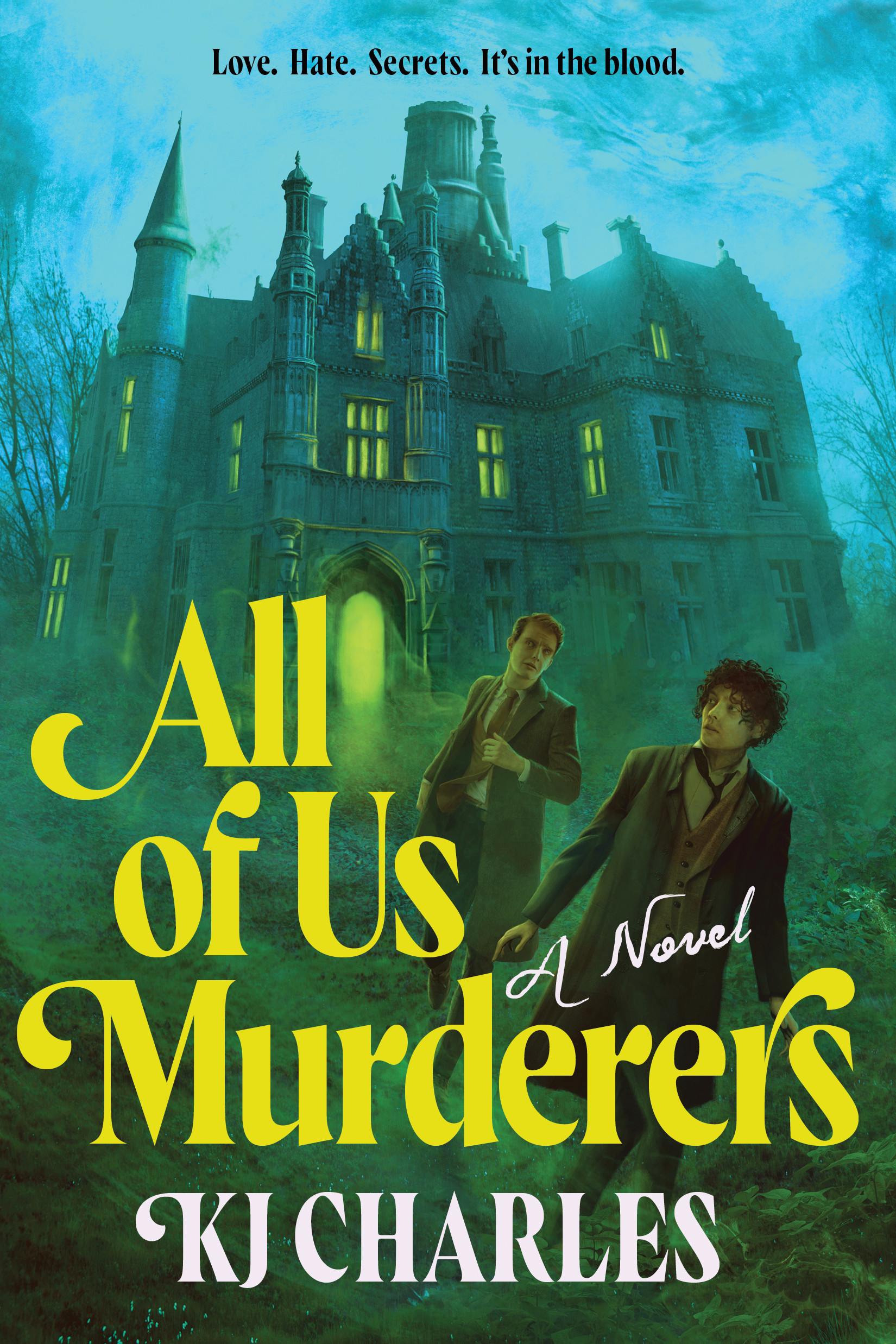
Synopsis: When Zeb Wyckham is summoned to a wealthy relative's remote Gothic manor, he is horrified to find all the people he least wants to see in the world: his estranged brother, his sneering cousin, and his bitter ex-lover Gideon Grey. Things couldn't possibly get worse.
Then the master of the house announces the true purpose of the gathering: he intends to leave the vast family fortune to whoever marries his young ward, setting off a violent scramble for her hand. Zeb wants no part of his greedy family―but when he tries to leave, the way is barred. The walls of Lackaday House are high, and the gates firmly locked. As the Dartmoor mists roll in, there's no way out. And something unnatural may be watching them from the house's shadowy depths…
Fear and paranoia ramping ever-higher, Zeb has nowhere to turn but to the man who once held his heart. As the gaslight flickers and terror takes hold, can two warring lovers reunite, uncover the murderous mysteries of Lackaday House―and live to tell the tale?
My thoughts: Overall I thought this was a pretty interesting book with an intriguing mystery. I commend the author for executing the mystery and the setting well; I think someone who was less skilled would have turned this into something a bit too ridiculous or fantastical. I think it’s because most things were grounded in reality, instead of in the supernatural. For example, the idea of a haunted mansion that you’re not allowed to leave could be over the top, but Lackaday House wasn’t really haunted, it was actually just really uncomfortable (physically, being cold, in disrepair, etc, but also emotionally, filled with hostile staff and overtly hostile other guests), and the reason that you couldn’t leave the grounds because the mist (a natural, common phenomenon) was so thick that it makes it treacherous to wander around, and also that the host specifically asked you to not leave, so you have to stay out of social obligation. I thought the cast of characters was pretty interesting; everyone felt strange but distinct. I specifically thought it was funny that the “token female” character, Elise, was surrounded by a group of ridiculous men. It felt very Almost Friday-core. For the main character Zeb, I thought he was really interesting to experience the story through. I liked his combination of relative sanity, but also getting a window into his ADHD, and what it would have looked like in a historical context (eg. fidgeting with prayer beads). I specifically liked the reveal that Zeb was a successful published author because it demonstrated ADHD as a strength, which I would have liked to see a bit more with regards to the main mystery of the book.
Rating: 4/5 rosary beads that you have to clack around just to focus on something
Finding Flora by Elinor Florence

Synopsis: In 1905, Scottish newcomer Flora Craigie jumps from a moving train to escape her abusive husband. Desperate to disappear, she claims a homestead near Alix, Alberta, determined to start a new life for herself. She finds that her nearest neighbours are also a Welsh widow with three children; two American women raising chickens; and a Métis woman who makes a living by breaking in wild horses.
While battling the harsh environment (and draconian local attitudes toward female farmers), the five women grapple with the differences of their backgrounds and the secrets each struggles to keep. When their homes are threatened with expropriation by the hostile federal Minister of the Interior, the women join forces to “fire the heather,” a Scottish term meaning raising a ruckus. And as the competition for land along the new Canadian Pacific railway line heats up, Flora’s violent husband closes in, and an unscrupulous land agent threatens the lives and livelihoods of the women just as they’re coming into their own.
My thoughts: I thought this book was a very cool slice of Canadian history. I was definitely soyfacing when historical figures like Irene Parlby (a member of the Famous Five and overall I really appreciated that it felt thoroughly Canadian. I thought Flora’s struggle as a single female homesteader in a new land was particularly poignant; it really underlined the immense struggle that newcomers and refugees can face across time and history. I loved the small community of women that Flora was able to build up, and I definitely loved that at the end she didn’t have to sacrifice her farm in order to find a husband (which I was definitely worried about, especially since villagers in the book constantly eschewed people who took a homestead, worked it, and then sold it just so that they could fund their move to somewhere else).
Rating: 3/5 barnraisers for a field that was mysteriously razed
i am, your most faithful blogger, elisa