Encountering Ants
I saw them hurrying from either side and each shade kissed another, without pausing, Each by the briefest society satisfied.
(Ants in their dark ranks, meet exactly so, rubbing each other’s noses, to ask perhaps What luck they’ve had, or which way they should go.)
—Dante, Purgatorio, Canto XXVI
I’m sure I’m not alone in this, but I love to read specific books at specific times. I read Around the World in 80 Days whenever I’m on a road trip. I read The Plague whenever I get sick¹. And every spring, I find myself reading Ant Encounters by Deborah Gordon.
I’m not sure why I find ants so interesting. My fascination with them certainly doesn’t carry over to any other bug or insect, which for the most part I am grossed out by. All creepy crawlies, really. I had pet hermit crabs as a kid and while my brothers were happy to hold them, I could not stand the feeling of their tiny legs crawling across my palm. Spiders I have a primal aversion to. I do not want to touch moths, caterpillars, grasshoppers, beetles, bees, or ladybugs.
But ants I’m chill with.
I think it must’ve come from a place of early childhood wonder and confusion: How do ants actually do anything?
Have you ever been walking down the sidewalk and seen a large black splotch on the pavement… only to realize it's a swarm of ants moving a discarded lollipop? Then you know the experience. Hundreds, thousands, of tiny critters all working together under a single will to achieve things otherwise impossible for them.
Somehow these vast and complex ant colonies build nests, forage for food, wage wars with other colonies, farm fungus, weave nests from larvae silk, kill plants with acid injection, conduct raids across forests, and cover food with leaves to hide it from scavengers. And believe me, ants do not have very big brains! So, how does it all get done?
The answer to how ants are able to do this changes as our own understanding of organization evolves. Let’s jump into Gordon’s Ant Encounters to learn about two of my favourite things: dynamic systems theory… and ants!
I suppose it’s only natural I love ants because I am equally fascinated by dynamic, complex, non-linear systems. I remember being a first year university student and watching videos on Youtube about those bird flock simulations known as boids. I’m sure anyone who has a computer science degree has seen these before…
Beautiful boids flying together in a virtual sky.
What makes boids so interesting — in my opinion — is how this behaviour emerges from extremely simplistic rules programmed into each boid. Just three rules:
1) Separation – Each boid moves away from other boids nearby to avoid collisions.
2) Alignment – Each boid adjusts its velocity to the average of boids around it, causing the flock to move in a general direction.
3) Cohesion – Each boid steers towards the average center of mass of boids around it, ensuring group integrity.
There is no global pattern or overseer that the little arrows are following. From these three simple internal rules, complex flocking patterns emerge, just like in real life. Similar rules govern real birds, swarms of fish, flying insects. Even groups of people driving cars are a sort of dynamic system. There are more rules than just three, but from very simple interactions (stop at red, drive at green, let pedestrians cross, etc.) a self-adjusting and self-sufficient system is born that works… most of the time. When it fails, it’s catastrophic and you are stuck in traffic for hours and hours… but it's still impressive that we can shuttle thousands of people on asphalt grids with minimal inter-vehicle communication between them all.
Ant Encounters starts off with a historical account of ant research. As long as there have been humans, there have been humans fascinated with ants². As we saw in Purgatorio at the top of the article (which is also quoted at the beginning of the book), Dante poetically muses that ants rub noses as a way to tell each other what to do and where to go. In Proverbs 6:6, we read: “Look to the ant, thou sluggard—consider her ways and be wise. Without chief, overseer or ruler, she gathers the harvest in the summer to eat in the winter.”
Yes, sluggard, consider the ant!
But don’t ants have a ruler? What about their queen?
It is true that in all 11,000 species of ants, there is always a single (or a few) reproductive females which lay eggs while the rest are sterile worker females. However, the history of the term ‘queen’ comes from 1609 in Charles Butler’s The Feminine Monarchie, or the Historie of Bees, where bees are described as loyal workers, toiling away happily under a benevolent monarch. The idea quickly spread to those researching ants and the name stuck. Monarchy then wasn’t just another human political invention, it was a reflection of the cultivated perfection found within Nature… but 200 years later, this view was beginning to change.
“In a lively discussion in the Ecole Normale in Paris in 1795, year 3 of the French Revolution, Daubenton, a professor of natural history, argued that there is no royalty in nature—for example, the queen bee does nothing more than lay eggs. His colleague Latreille wrote in 1798 that the ants in the colony are not really subjugated workers; instead, the colony has 'a single will, a single law' based on the love each ant feels for the others.” (pg. 2)
As political structures around Europe twisted and turned and flipped, so did the way we see and investigate nature. Kropotkin, famous anarchist writer, sees in woodcutter ants co-operation rather than competition as the driving force in natural organization. Even towards the current day, we see modern life and fears reflected in our tiny friends.
“In The Book of Merlyn by T. H. White, Merlin transforms the young Arthur into an ant and sends him to work in a desolate tunnel with loudspeakers blaring allegiance to an ant Big Brother and walls plastered with signs reading 'Everything not forbidden is compulsory.' More recently, movies such as Antz, It’s a Bug’s Life, and The Ant Bully show the colony as a corporation with more or less disgruntled workers.” (pg. 4)
As modern ecology begins to come out of the 19th and 20th century, an interesting point is made: individual ants don’t actually reproduce. Colonies reproduce, by sending out new queens and males to mate with other colony representatives. Ants don’t create new ants. Colonies create new colonies. In an ecological sense, it’s not the ant which is the organism, but the colony itself; a sort of “super-organism” wherein all the ants make up the cells and organs and internal processes.
It’s like a body without skin needing to hold everything together, where the parts freely move about, arranging and moving food, waste, and eggs. A colony is, in a sense, those cells — and a nest is its temporary body. In some ways, the ants are also like individual neurons in a brain. I hope I’m not pressing the point too hard, but I just find the concept of a super-organism so bizarre and alien, a body made of bodies, that I really want to emphasize it. If your world is not enchanted, you are not paying enough attention.
Okay but enough of this (I hear you say), enough about boids and Dante and Antz, how do ants actually organize if there is no king or queen or dictator or project manager?
Well, let’s start with what ants actually do.
Gordon mostly focuses on red harvester ants (Pogonomyrmex barbatus) for her research, so we will follow her description of their roles. Here is a picture of the fellas so you can envision them in your head (or I guess if you have no thought imagery you can just keep scrolling up to look at them every now and then):
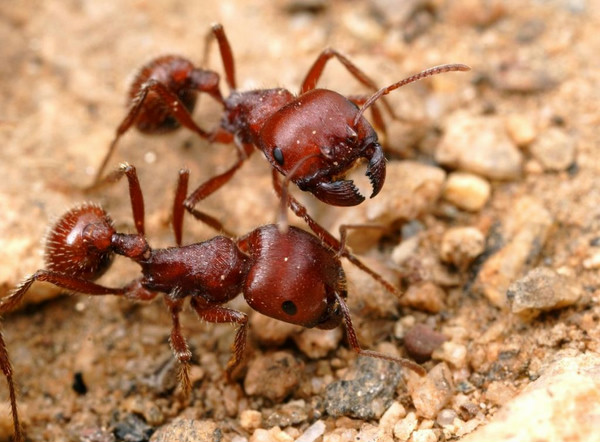 Red harvester ants. So cute!
“These seed-eating ants are common in the deserts and dry grasslands of the south-western United States, Mexico, and South America. Four tasks are performed outside the nest: foraging, patrolling, nest colony organization maintenance work, and midden work. Foragers travel away from the nest in streams reaching 10 to 30 meters from the nest and then fan out and search for seeds, which they bring back to the nest to be processed and stored. The patrollers are the first ants to leave the nest in the morning. They search the nest mound and foraging area, and choose the day’s foraging directions. It is the return of the patrollers that stimulates the foragers to begin their work for the day. Nest maintenance workers carry out the dry soil that collects inside the nest during the excavation and repair of underground chambers. Midden workers manipulate and sort the refuse pile, or midden.” (pg. 30-31)
That gives us four rough categories of work ants: 1) Foragers 2) Patrollers 3) Nest maintenance/brood care 4) Midden workers
You might be tempted to think that there are different types of ants for different roles, as I thought the same before doing further research. This is especially tempting in species with different sizes of ants within the same colony. But this would be a very unstable system. What happens if all the foragers are wiped out on patrol during a rainstorm, or all the midden workers are crushed by a cave-in? Research has also shown that even in the minority of ant species with size differentiation (only 44 of the 263 genera), there is little difference in task effectiveness between ants of different sizes. It's not so much a division of labour where some ants are born for foraging and others for midden work, but instead a term Gordon calls Task Allocation. Each of the four categories of work an ant can do is a specific task. What an ant is doing at any given time is dependent on what other ants are doing and what it is currently doing itself.
“I found that ants switch tasks if more ants are needed to perform a particular task. Not all transitions are possible. If more foragers are needed, workers of the other three tasks will switch tasks to forage. If more patrollers are needed, nest maintenance workers will switch tasks to patrolling. If more nest maintenance workers are needed, they must be recruited from the younger workers inside the nest. Then, once a worker becomes a forager, it does not switch back to any other task. Thus, foraging acts as a sink, while the younger workers inside the nest, who will be recruited to nest maintenance if needed, act as a source.” (pg. 32)
So through the life cycle of an ant (around one year for red harvester ants), it will go from an egg to a larva to a pupa to an adult. After emerging from its pupa cocoon, it immediately begins brood care — taking care of other pupa and larva, i.e. spawn in and keep doing what others were doing to help spawn you in. After some time and noticing there aren’t enough nest maintenance workers, it will switch to nest maintenance. Then if there aren’t enough patrollers, it will switch to being a patroller, and then finally to a forager if necessary. Foraging works as a sink because it often ends in predation or other death.
Now for the final piece of our puzzle: how do ants know when to switch tasks?
This comes back to what our old friend Dante³ said at the start of our article: rubbing noses. Ants have extremely limited senses. Most are limited to vague sensations of light/dark, water, vibrations. Where ants excel is their sense of smell, from which they can detect chemical signals, trail markers, members of their own brood or rival colonies, food, poison, and a host of different signals.
“The most important sensory mode of ants is olfaction. Ants use their antennae to perceive odors from objects they touch with their antennae or from the air.” (pg. 37)
So then do touching ants send signals to each other about what to do? “Need help here” one scent says, “More foragers this way, please” another smell goes. Nope, it’s much more simple and elegant than that.
“An ant uses its recent experience of interactions to decide what to do. The pattern of interaction itself, rather than any signal transferred, acts as the message.” (pg. 47-48)
The medium IS the message, literally!
“What matters is not what one ant tells another when they meet, but simply that they meet. An ant operates according to a rule such as, “If I meet another ant with odor A about three times in the next 30 seconds, I will go out to forage; if not, I will stay here.” The rules are actually more probabilistic than that—more like, “If I meet another ant with odor A about three times in the next 30 seconds, the probability that I will go out to forage will increase by about 10%; if not, it will go down by about 20%.” (pg. 48)
It's all about ants encountering ants⁴. From a series of these hard-wired, instinctual rules, ant colonies move and breathe with a fierce group intelligence. And just like boids, it’s relatively simplistic rules that in aggregate regulate the colony work allocation. No queen needed! How these individual instincts are coded or how they evolved as such I will leave as a question for science and God, but the mechanism remains as beautiful clockwork.
This ties back to how an ant switches from one task to another. If there is no change in its environment, it resumes the same task as the day before. If there are significant changes, it can reallocate itself to balance the colony equilibrium.
“An early example of the effect of interaction rate on task allocation is Wilson’s 1985 result that when the smaller workers, or minors, of Pheidole pubiventris species are removed, the larger ones, or majors, switch to perform brood care. This is the outcome of a simple rule of interaction: when majors met minors near the brood pile, they turned away. When minors were removed, there were fewer minors around. This meant that majors were less likely to meet minors and instead more likely to encounter other majors, and so they did not turn away, but instead stayed to help with the brood.” (pg. 49)
This smoothly replaces a suffering worker population. As more ants transition to brood work, it becomes more probable a wandering ant will encounter brood workers, and then less probable it will switch to that task.
To better illustrate this ‘interaction as the message’, Gordon gives us an experiment done to artificially prompt the ants to start foraging early. If you remember from before… patrollers go out in the morning and on arrival back, trigger the foragers to leave.
“Colony activity begins early in the morning, when a small group of patrollers leave the nest mound. This is probably stimulated by the warmth of the first touch of sunlight in the nest entrance; nests in the shade tend to begin patrolling later. The first patrollers meander around the foraging area, and eventually return to the nest. Foragers are stimulated to leave the nest for the first time in the morning by the return of the patrollers. If patrollers are prevented from returning, the foragers do not emerge. What guarantee do the returning patrollers provide? If a patroller can leave and return safely, without getting blown away by heavy wind or eaten by a horned-lizard predator, then so can a forager. The patrollers also put down a chemical on the nest mound that shows the foragers which direction to take when they leave the nest;” (pg. 51)
“We then replaced the patrollers with patroller mimics: little glass beads coated with extract of hydrocarbons from that colony’s patrollers. We dropped glass beads into the nests of colonies whose patrollers had not returned. Glass beads treated with patroller hydrocarbon extract stimulated foraging. Glass beads treated with hydrocarbon extract from another task, nest maintenance, or treated only with solvent as a control, did not stimulate foraging activity. Contact with beads that smell like a patroller is enough to stimulate the foragers to leave the nest.” (pg. 52)
“The rate at which patrollers return is crucial to stimulate foraging. Glass beads that smell like patrollers do not stimulate foraging unless they are introduced at the correct rate. Foraging begins when patrollers return at a rate of about 6 per minute or 1 per 10 seconds, and glass beads must be introduced at a rate of 1 per 10 seconds or foraging does not begin. One of the few ways we have ever succeeded in getting ants to do our bidding was to drop in beads coated with patroller extract at the rate of 1 per 10 seconds before foraging began. We were able to trick colonies into starting to forage earlier.” (pg. 52)
Awesome! I wish my job was to trick ants with smelly glass beads!
You could also see how these micro-interactions can quickly propagate across a group of ants, even across the entire colony, in a matter of moments.
“Many ant species use chemicals to signal alarm. Alarm pheromones are volatile, dispersing quickly in the air. Alarmed ants often run around in circles, sending out more pheromone that gets more ants running around in circles, so there is a spreading wave of alarmed ants. Alarmed ants are likely to react aggressively to whatever they meet as they dash around.” (pg. 40)
Before I go on, I want to mention a cool tidbit from the book that ties into this interaction story. I’m sure you have heard of that experiment where an ant was covered in ‘death pheromones’ and taken to the midden (trash/graveyard of the hive) by fellow hivemates, still kickin’ and screamin’. This experiment isn’t pop culture science, it is a real experiment and it does prove how much olfaction drives ants behavior. But as Gordon explains, the common story you hear leaves out a crucial detail: the “dead” ants were covered in death pheromones AFTER the scientists cooled them in a fridge until they stopped moving. Aw c’mon, that’s cheating! I’d like you to try to tell if someone is alive if giant aliens paralyzed them and made their heartbeat undetectable!
Still, there are many mysteries about ant life and memory. How long can an ant really remember something? Most of the behaviour is instinctual and automatic, but still trails need to be remembered and jobs need to be tracked. I’ll leave you with a final anecdote from Gordon’s research:
“Rosengren found that in the spring, an older ant, which survived over the winter, leads a young ant out on its preferred trail. Then the old ant dies, and the young ant adopts that trail. The older forager must remember to go on the same trail at the end of the winter as it did in the autumn, and the young forager must remember, from one day to the next, to go on the trail that the older one showed it the day before—but the colony remembers the trail for decades.” (pg. 62)
Ant intern to senior worker… :’)
If any of this interests you in the slightest, I’d give Ant Encounters a try. Especially in the Spring, once the snow begins to melt and you can read it in the park on a picnic blanket. It’s quite short too, around 180 pages. I only discussed some of the history and ant interactions, the rest of the book is full of discussion about ant colony life cycles, colony interactions, and all sorts of other goodies, including many fun insect anecdotes from Gordon’s decades of studies.
The truth is that, even now, we know next to nothing about ants. Of the 11,000 species, only about 50 have really been studied in depth. And it is hard to study ant life, given how small they are. I’m sure you can imagine how difficult it is to even detect the micro-scents that govern so much of their miniscule lives. Most of the experiments Gordon herself conducted had to be done by capturing ants and marking them with tiny dots of paint. That’s not light work!
Some of the biggest mysteries are around early life for ants… It’s tough to mark and inspect ants deep underground inside a nest without fundamentally altering that nest. Many mysteries have been solved, but ants still find ways to surprise and impress us. I’m sure as our human understanding of organization and complexity changes, so will our relation to our tiny friends.
“Not many people have taken the time to watch ants carefully. In the nineteenth century, the English took their obsessions with birds and wildflowers around the world, to the great benefit of ornithology and botany, but have you ever heard of a local ant-watchers club?” (pg. 16)
Well…. anyone want to start one?
Stay frosty, Noah Ant-Watchers Club – 001 – York Region Chapter