Noah

Above the door is the cryptic inscription "Feel Free."

I saw them hurrying from either side and each shade kissed another, without pausing, Each by the briefest society satisfied.

(Ants in their dark ranks, meet exactly so, rubbing each other’s noses, to ask perhaps What luck they’ve had, or which way they should go.)

—Dante, Purgatorio, Canto XXVI


I’m sure I’m not alone in this, but I love to read specific books at specific times. I read Around the World in 80 Days whenever I’m on a road trip. I read The Plague whenever I get sick¹. And every spring, I find myself reading Ant Encounters by Deborah Gordon.

I’m not sure why I find ants so interesting. My fascination with them certainly doesn’t carry over to any other bug or insect, which for the most part I am grossed out by. All creepy crawlies, really. I had pet hermit crabs as a kid and while my brothers were happy to hold them, I could not stand the feeling of their tiny legs crawling across my palm. Spiders I have a primal aversion to. I do not want to touch moths, caterpillars, grasshoppers, beetles, bees, or ladybugs.

But ants I’m chill with.

I think it must’ve come from a place of early childhood wonder and confusion: How do ants actually do anything?

Have you ever been walking down the sidewalk and seen a large black splotch on the pavement… only to realize it's a swarm of ants moving a discarded lollipop? Then you know the experience. Hundreds, thousands, of tiny critters all working together under a single will to achieve things otherwise impossible for them.

Somehow these vast and complex ant colonies build nests, forage for food, wage wars with other colonies, farm fungus, weave nests from larvae silk, kill plants with acid injection, conduct raids across forests, and cover food with leaves to hide it from scavengers. And believe me, ants do not have very big brains! So, how does it all get done?

The answer to how ants are able to do this changes as our own understanding of organization evolves. Let’s jump into Gordon’s Ant Encounters to learn about two of my favourite things: dynamic systems theory… and ants!


I suppose it’s only natural I love ants because I am equally fascinated by dynamic, complex, non-linear systems. I remember being a first year university student and watching videos on Youtube about those bird flock simulations known as boids. I’m sure anyone who has a computer science degree has seen these before…

Boids! Beautiful boids flying together in a virtual sky.

What makes boids so interesting — in my opinion — is how this behaviour emerges from extremely simplistic rules programmed into each boid. Just three rules:

1) Separation – Each boid moves away from other boids nearby to avoid collisions.

2) Alignment – Each boid adjusts its velocity to the average of boids around it, causing the flock to move in a general direction.

3) Cohesion – Each boid steers towards the average center of mass of boids around it, ensuring group integrity.

There is no global pattern or overseer that the little arrows are following. From these three simple internal rules, complex flocking patterns emerge, just like in real life. Similar rules govern real birds, swarms of fish, flying insects. Even groups of people driving cars are a sort of dynamic system. There are more rules than just three, but from very simple interactions (stop at red, drive at green, let pedestrians cross, etc.) a self-adjusting and self-sufficient system is born that works… most of the time. When it fails, it’s catastrophic and you are stuck in traffic for hours and hours… but it's still impressive that we can shuttle thousands of people on asphalt grids with minimal inter-vehicle communication between them all.

Ant Encounters starts off with a historical account of ant research. As long as there have been humans, there have been humans fascinated with ants². As we saw in Purgatorio at the top of the article (which is also quoted at the beginning of the book), Dante poetically muses that ants rub noses as a way to tell each other what to do and where to go. In Proverbs 6:6, we read: “Look to the ant, thou sluggard—consider her ways and be wise. Without chief, overseer or ruler, she gathers the harvest in the summer to eat in the winter.”

Yes, sluggard, consider the ant!

But don’t ants have a ruler? What about their queen?

It is true that in all 11,000 species of ants, there is always a single (or a few) reproductive females which lay eggs while the rest are sterile worker females. However, the history of the term ‘queen’ comes from 1609 in Charles Butler’s The Feminine Monarchie, or the Historie of Bees, where bees are described as loyal workers, toiling away happily under a benevolent monarch. The idea quickly spread to those researching ants and the name stuck. Monarchy then wasn’t just another human political invention, it was a reflection of the cultivated perfection found within Nature… but 200 years later, this view was beginning to change.

“In a lively discussion in the Ecole Normale in Paris in 1795, year 3 of the French Revolution, Daubenton, a professor of natural history, argued that there is no royalty in nature—for example, the queen bee does nothing more than lay eggs. His colleague Latreille wrote in 1798 that the ants in the colony are not really subjugated workers; instead, the colony has 'a single will, a single law' based on the love each ant feels for the others.” (pg. 2)

As political structures around Europe twisted and turned and flipped, so did the way we see and investigate nature. Kropotkin, famous anarchist writer, sees in woodcutter ants co-operation rather than competition as the driving force in natural organization. Even towards the current day, we see modern life and fears reflected in our tiny friends.

“In The Book of Merlyn by T. H. White, Merlin transforms the young Arthur into an ant and sends him to work in a desolate tunnel with loudspeakers blaring allegiance to an ant Big Brother and walls plastered with signs reading 'Everything not forbidden is compulsory.' More recently, movies such as Antz, It’s a Bug’s Life, and The Ant Bully show the colony as a corporation with more or less disgruntled workers.” (pg. 4)

As modern ecology begins to come out of the 19th and 20th century, an interesting point is made: individual ants don’t actually reproduce. Colonies reproduce, by sending out new queens and males to mate with other colony representatives. Ants don’t create new ants. Colonies create new colonies. In an ecological sense, it’s not the ant which is the organism, but the colony itself; a sort of “super-organism” wherein all the ants make up the cells and organs and internal processes.

It’s like a body without skin needing to hold everything together, where the parts freely move about, arranging and moving food, waste, and eggs. A colony is, in a sense, those cells — and a nest is its temporary body. In some ways, the ants are also like individual neurons in a brain. I hope I’m not pressing the point too hard, but I just find the concept of a super-organism so bizarre and alien, a body made of bodies, that I really want to emphasize it. If your world is not enchanted, you are not paying enough attention.


Okay but enough of this (I hear you say), enough about boids and Dante and Antz, how do ants actually organize if there is no king or queen or dictator or project manager?

Well, let’s start with what ants actually do.

Gordon mostly focuses on red harvester ants (Pogonomyrmex barbatus) for her research, so we will follow her description of their roles. Here is a picture of the fellas so you can envision them in your head (or I guess if you have no thought imagery you can just keep scrolling up to look at them every now and then):
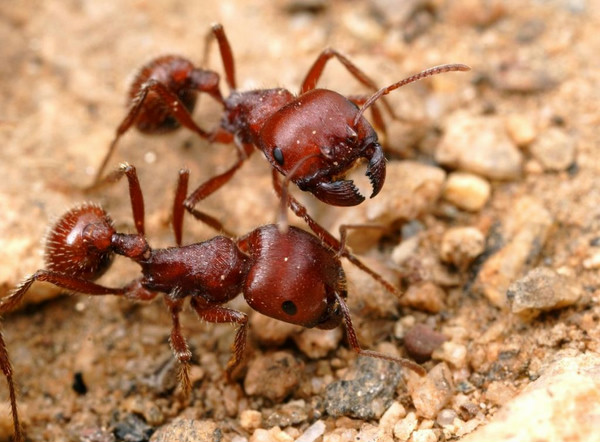
Red Harvester Ants Red harvester ants. So cute!

“These seed-eating ants are common in the deserts and dry grasslands of the south-western United States, Mexico, and South America. Four tasks are performed outside the nest: foraging, patrolling, nest colony organization maintenance work, and midden work. Foragers travel away from the nest in streams reaching 10 to 30 meters from the nest and then fan out and search for seeds, which they bring back to the nest to be processed and stored. The patrollers are the first ants to leave the nest in the morning. They search the nest mound and foraging area, and choose the day’s foraging directions. It is the return of the patrollers that stimulates the foragers to begin their work for the day. Nest maintenance workers carry out the dry soil that collects inside the nest during the excavation and repair of underground chambers. Midden workers manipulate and sort the refuse pile, or midden.” (pg. 30-31)

That gives us four rough categories of work ants: 1) Foragers 2) Patrollers 3) Nest maintenance/brood care 4) Midden workers

You might be tempted to think that there are different types of ants for different roles, as I thought the same before doing further research. This is especially tempting in species with different sizes of ants within the same colony. But this would be a very unstable system. What happens if all the foragers are wiped out on patrol during a rainstorm, or all the midden workers are crushed by a cave-in? Research has also shown that even in the minority of ant species with size differentiation (only 44 of the 263 genera), there is little difference in task effectiveness between ants of different sizes. It's not so much a division of labour where some ants are born for foraging and others for midden work, but instead a term Gordon calls Task Allocation. Each of the four categories of work an ant can do is a specific task. What an ant is doing at any given time is dependent on what other ants are doing and what it is currently doing itself.

“I found that ants switch tasks if more ants are needed to perform a particular task. Not all transitions are possible. If more foragers are needed, workers of the other three tasks will switch tasks to forage. If more patrollers are needed, nest maintenance workers will switch tasks to patrolling. If more nest maintenance workers are needed, they must be recruited from the younger workers inside the nest. Then, once a worker becomes a forager, it does not switch back to any other task. Thus, foraging acts as a sink, while the younger workers inside the nest, who will be recruited to nest maintenance if needed, act as a source.” (pg. 32)

So through the life cycle of an ant (around one year for red harvester ants), it will go from an egg to a larva to a pupa to an adult. After emerging from its pupa cocoon, it immediately begins brood care — taking care of other pupa and larva, i.e. spawn in and keep doing what others were doing to help spawn you in. After some time and noticing there aren’t enough nest maintenance workers, it will switch to nest maintenance. Then if there aren’t enough patrollers, it will switch to being a patroller, and then finally to a forager if necessary. Foraging works as a sink because it often ends in predation or other death.


Now for the final piece of our puzzle: how do ants know when to switch tasks?

This comes back to what our old friend Dante³ said at the start of our article: rubbing noses. Ants have extremely limited senses. Most are limited to vague sensations of light/dark, water, vibrations. Where ants excel is their sense of smell, from which they can detect chemical signals, trail markers, members of their own brood or rival colonies, food, poison, and a host of different signals.

“The most important sensory mode of ants is olfaction. Ants use their antennae to perceive odors from objects they touch with their antennae or from the air.” (pg. 37)

So then do touching ants send signals to each other about what to do? “Need help here” one scent says, “More foragers this way, please” another smell goes. Nope, it’s much more simple and elegant than that.

“An ant uses its recent experience of interactions to decide what to do. The pattern of interaction itself, rather than any signal transferred, acts as the message.” (pg. 47-48)

The medium IS the message, literally!

“What matters is not what one ant tells another when they meet, but simply that they meet. An ant operates according to a rule such as, “If I meet another ant with odor A about three times in the next 30 seconds, I will go out to forage; if not, I will stay here.” The rules are actually more probabilistic than that—more like, “If I meet another ant with odor A about three times in the next 30 seconds, the probability that I will go out to forage will increase by about 10%; if not, it will go down by about 20%.” (pg. 48)

It's all about ants encountering ants. From a series of these hard-wired, instinctual rules, ant colonies move and breathe with a fierce group intelligence. And just like boids, it’s relatively simplistic rules that in aggregate regulate the colony work allocation. No queen needed! How these individual instincts are coded or how they evolved as such I will leave as a question for science and God, but the mechanism remains as beautiful clockwork.

This ties back to how an ant switches from one task to another. If there is no change in its environment, it resumes the same task as the day before. If there are significant changes, it can reallocate itself to balance the colony equilibrium.

“An early example of the effect of interaction rate on task allocation is Wilson’s 1985 result that when the smaller workers, or minors, of Pheidole pubiventris species are removed, the larger ones, or majors, switch to perform brood care. This is the outcome of a simple rule of interaction: when majors met minors near the brood pile, they turned away. When minors were removed, there were fewer minors around. This meant that majors were less likely to meet minors and instead more likely to encounter other majors, and so they did not turn away, but instead stayed to help with the brood.” (pg. 49)

This smoothly replaces a suffering worker population. As more ants transition to brood work, it becomes more probable a wandering ant will encounter brood workers, and then less probable it will switch to that task.

To better illustrate this ‘interaction as the message’, Gordon gives us an experiment done to artificially prompt the ants to start foraging early. If you remember from before… patrollers go out in the morning and on arrival back, trigger the foragers to leave.

“Colony activity begins early in the morning, when a small group of patrollers leave the nest mound. This is probably stimulated by the warmth of the first touch of sunlight in the nest entrance; nests in the shade tend to begin patrolling later. The first patrollers meander around the foraging area, and eventually return to the nest. Foragers are stimulated to leave the nest for the first time in the morning by the return of the patrollers. If patrollers are prevented from returning, the foragers do not emerge. What guarantee do the returning patrollers provide? If a patroller can leave and return safely, without getting blown away by heavy wind or eaten by a horned-lizard predator, then so can a forager. The patrollers also put down a chemical on the nest mound that shows the foragers which direction to take when they leave the nest;” (pg. 51)

“We then replaced the patrollers with patroller mimics: little glass beads coated with extract of hydrocarbons from that colony’s patrollers. We dropped glass beads into the nests of colonies whose patrollers had not returned. Glass beads treated with patroller hydrocarbon extract stimulated foraging. Glass beads treated with hydrocarbon extract from another task, nest maintenance, or treated only with solvent as a control, did not stimulate foraging activity. Contact with beads that smell like a patroller is enough to stimulate the foragers to leave the nest.” (pg. 52)

“The rate at which patrollers return is crucial to stimulate foraging. Glass beads that smell like patrollers do not stimulate foraging unless they are introduced at the correct rate. Foraging begins when patrollers return at a rate of about 6 per minute or 1 per 10 seconds, and glass beads must be introduced at a rate of 1 per 10 seconds or foraging does not begin. One of the few ways we have ever succeeded in getting ants to do our bidding was to drop in beads coated with patroller extract at the rate of 1 per 10 seconds before foraging began. We were able to trick colonies into starting to forage earlier.” (pg. 52)

Awesome! I wish my job was to trick ants with smelly glass beads!

You could also see how these micro-interactions can quickly propagate across a group of ants, even across the entire colony, in a matter of moments.

“Many ant species use chemicals to signal alarm. Alarm pheromones are volatile, dispersing quickly in the air. Alarmed ants often run around in circles, sending out more pheromone that gets more ants running around in circles, so there is a spreading wave of alarmed ants. Alarmed ants are likely to react aggressively to whatever they meet as they dash around.” (pg. 40)

Before I go on, I want to mention a cool tidbit from the book that ties into this interaction story. I’m sure you have heard of that experiment where an ant was covered in ‘death pheromones’ and taken to the midden (trash/graveyard of the hive) by fellow hivemates, still kickin’ and screamin’. This experiment isn’t pop culture science, it is a real experiment and it does prove how much olfaction drives ants behavior. But as Gordon explains, the common story you hear leaves out a crucial detail: the “dead” ants were covered in death pheromones AFTER the scientists cooled them in a fridge until they stopped moving. Aw c’mon, that’s cheating! I’d like you to try to tell if someone is alive if giant aliens paralyzed them and made their heartbeat undetectable!

Still, there are many mysteries about ant life and memory. How long can an ant really remember something? Most of the behaviour is instinctual and automatic, but still trails need to be remembered and jobs need to be tracked. I’ll leave you with a final anecdote from Gordon’s research:

“Rosengren found that in the spring, an older ant, which survived over the winter, leads a young ant out on its preferred trail. Then the old ant dies, and the young ant adopts that trail. The older forager must remember to go on the same trail at the end of the winter as it did in the autumn, and the young forager must remember, from one day to the next, to go on the trail that the older one showed it the day before—but the colony remembers the trail for decades.” (pg. 62)

Ant intern to senior worker… :’)


If any of this interests you in the slightest, I’d give Ant Encounters a try. Especially in the Spring, once the snow begins to melt and you can read it in the park on a picnic blanket. It’s quite short too, around 180 pages. I only discussed some of the history and ant interactions, the rest of the book is full of discussion about ant colony life cycles, colony interactions, and all sorts of other goodies, including many fun insect anecdotes from Gordon’s decades of studies.

The truth is that, even now, we know next to nothing about ants. Of the 11,000 species, only about 50 have really been studied in depth. And it is hard to study ant life, given how small they are. I’m sure you can imagine how difficult it is to even detect the micro-scents that govern so much of their miniscule lives. Most of the experiments Gordon herself conducted had to be done by capturing ants and marking them with tiny dots of paint. That’s not light work!

Some of the biggest mysteries are around early life for ants… It’s tough to mark and inspect ants deep underground inside a nest without fundamentally altering that nest. Many mysteries have been solved, but ants still find ways to surprise and impress us. I’m sure as our human understanding of organization and complexity changes, so will our relation to our tiny friends.

“Not many people have taken the time to watch ants carefully. In the nineteenth century, the English took their obsessions with birds and wildflowers around the world, to the great benefit of ornithology and botany, but have you ever heard of a local ant-watchers club?” (pg. 16)

Well…. anyone want to start one?

Stay frosty, Noah Ant-Watchers Club – 001 – York Region Chapter

¹ It’s a short book that you finish in a few days as you start to feel better. And the whole time I’m thinking “I may be sick… but at least I don’t have the plague…” ² “In the Iliad, the Myrmidons, an army of selfless, fearless soldiers, were ants that had been turned into people by Zeus to repopulate an island decimated by the plague. The soldiers were antlike, despite their human form, in their dedication to the army and disregard for self.” (pg. 63) ³ I wish someone would make Dante’s Inferno for a modern age… and also make it set in Cambridge…. what a good idea that would be for a book… ⁴ Ding! Roll credits.

An anthropological investigation of a dead, pandemic-era Discord server

Portrait by Nick Verrelli

If I had a nickel for every Discord bot I have programmed, I would have two nickels.

The first was Verrelli Bot. Inspired by the bot work of Dom in our QCompSci messenger group chats, Verrelli Bot posted Markov-chains of Nick’s scraped (and now deleted) Twitter account. Good for a couple laughs and even as inspiration for a few tweets.

The second, Verrelli Bot 2, was my Javascript magnum opus.

What started as a replacement for the dogshit ranking system of MEE6 bot, soon spiralled into a full-blown economic and political model, spanning several eras and dynasties. It was the best of times, it was the worst of times. It was December 2020 to March 2021; and deep in the midst of an international lockdown, we had nothing better to do than log onto Discord every day. The whole period was a blur to me. I can’t remember doing much except sitting in my basement office, my remote work on one screen and Discord open on my Lenovo gaming laptop¹.

At the core of Verrelli Bot 2 was NoahCoin – the digital upgrade of my fiat, Dollar Store brand currency, NoahBuck. In the beginning, it only had a few commands. v-mine was utilized to gain a small, random amount of NoahCoin. v-transfer would send NoahCoin to another person. v-slots would gamble a choice number of NoahCoin in the emoji casino. This was enough to kickstart a grand economic rat race and a bot project ending with dozens of commands.

Recounting each server event that took place in the three months between the introduction of Verrelli Bot 2.0 (December 29th, 2020) and the end of the server (March 11th, 2021) would be as futile as it would be boring. But I would like to present an anthropological, archeological, and sociological analysis of one of the recovered artifacts from the server: The infamous decree which became known as The Char Accords.

NOTE: From here onward, “Verrelli Bot” and “v-bot” will be used interchangeably, referring to the Verrelli Bot 2.0 (and all subsequent versions).

The Accords

On January 22nd 2021, Char ascended to the role of sole ruler of the server, and pronounced his decree. The full text is featured below and was later reprinted in the Nick York Times issue of that same day.

Upon further analysis within its original cultural context, the Char Accords reveal a great amount of detail regarding day-to-day life within Discordian society under the Machine Age of Verrelli Bot.

1. Rather than Charcord, the city as a whole will establish the new name of the discord to promote democracy.

The First Accord reveals that democracy and democratic values were at the forefront of the public discourse on server ownership. The server, up until this point, was filled with backstabbing tyranny over the digital throne. Everyone wanted to be the king, and no one trusted anyone.

This raises the question: How did one become the server ruler?

If their NNCBC (National Noahcord Bank of Commerce) account equaled or surpassed one million NoahCoins (held in NNCBC accounts by v-bot), their account would be reset back to zero and they would be granted the ‘Supreme Chancellor’ role, replacing whoever held it last. With the Chancellor role, they would be able to access specific v-bot commands that others could not: v-decree, v-tax, v-gag, and v-deputy – to name a few.

Originally, the Supreme Chancellor role would be given to whoever had the most NoahCoins. However, this led to extreme NoahCoin wealth disparity, with some users ranking in the millions while some only had hundreds. To solve both the inequality and rising NoahCoin inflation, the Verrelli Bot 2.5 [Definitive Golden Edition] update came with an economic overhaul that would both even the playing field and remove excess NoahCoins from circulation.

In this text, Char is referring to v-name, a command that allowed the Chancellor to rename the server. Of course, they could do it manually with the Supreme Chancellor role, but there was greater fanfare in having the bot do it publicly.

By not immediately renaming the server to “Charcord”, Char attempted to distance himself from the narcissistic regimes that came before him – including his own previous Charcord.

Ancient Discordian professor and scholar Dr. Nicholas commented, “The Chancellor was so desperate to distance himself from his past self that he claimed it was a divergent personality responsible; a Dark Char, if you will.”

2. Curfew has been lifted.

The “curfew” was the NoahCoin Farming Curfew imposed by the prior Jagcord Administration. Notoriously unpopular among the general populace, it banned the use of the v-farm command between the hours of 8pm and 11am.

An explanation of the v-farm command from the Verrelli Bot 2.5 [Definitive Golden Edition] patchnotes (published January 11th, 2021) can be found below:

This v-farm command became a very popular alternative to the widely used v-mine. Though slower (the cool-down on v-mining changed from time to time, but generally remained around 5 minutes), the profit was worth the risk of others potentially stealing your hard-earned crops².

The curfew that the Jag Regime had imposed was to stop so-called “overnight tryhards” who clogged up everyone’s notifications with 3am v-farm and v-mine attempts.

When asked for a comment on the curfew, Jag said “You can call them tryhards, I call them bots. I couldn’t escape Alex and Nick’s partnership. They had a strong bond. This was my wrench.”

By undoing the curfew, Char made himself friendly to the average farming citizen, as well as the aforementioned Bambino-Nicholas Alliance.

3. V-Tax, following an inauguration taxation, has been abolished.

v-tax was one of the most contentious v-bot commands that a Chancellor could use. Once daily, a Chancellor could type v-tax [integer between 1 and 5] to withdraw that percentage from every active NoahBank account and place it within their own account. Universally despised, it was still used by almost every Chancellor to keep their pockets stuffed. Anything less than v-tax 5 was seldom used.

Even Char couldn’t escape the allure of one final tax payout.

As Nick adds, “The hypocrisy of final taxation did not do much to ingratiate the new Chancellor to his citizens and was met with bipartisan uproar.”

4. I will be launching v-grant, a system which grants 10,000 NoahCoin to the citizens of the cord.

v-grant was added to solve a particular problem in the server at the time – there wasn’t much to do once you ran out of NoahCoin. This was a common problem, given that many vagrants gambled away their life savings in the v-casino on the v-slots.

v-mine, which users could do once every 5-10 minutes, took too long and produced little gain. v-daily and v-startup were recently banned following an Anti-Communism Committee investigation.

Char attempted to make himself a provider, a saviour of the people, doling out free money day-by-day, granted that you keep him in power.

Bambino in Growing Up in Kaitcord: Life as a V-Farmer sarcastically comments, “The irony in watching later Chancellors start each morning with v-grant and then v-tax 5…”

5. V-Request abolished, to prevent those from sneakily peaking at opposing parties balances.

To become Chancellor, your NNCBC account had to equal or surpass one million. This would empty your account and give you the Supreme Chancellor role with all its admin privileges. This economic overhaul from the 2.5 update also spawned a new host of strategies designed to take control of the server. To start was the obvious: political factions would form and donate money to a single person, allowing them to become the leader. The donors would normally be granted some high ranking role in the new society, generally the Sheriff position.

There were more advanced tactics too. The Bambino-Nicholas alliance was notorious for offloading hundreds of thousands of NoahCoins into ‘offshore’, inactive member accounts, to be later v-heisted back.

Another common tactic was ‘Pushing over’, whereby rival factions would push an enemy bank account over the one million mark, zeroing out the account, and then immediately pushing an allied account over the million mark to snatch away the throne.

For example: Account A has 700,000 NoahCoin Account B has 800,000 NoahCoin Account C has 900,000 NoahCoin

Account A and B are allied against Account C. They could easily combine funds and take the Chancellor role. However, they want to make sure Account C has no easy way to stop their new rule. Account B first v-transfers 100,000 NoahCoin to Account C. Account C passes hits one million, becomes Chancellor, and their balance is back to 0.

Account A has 700,000 NoahCoin Account B has 700,000 NoahCoin Account C has 0 NoahCoin

Now, Account B v-transfers 300,000 NoahCoin to Account A, making them the new Chancellor, with their political rival now bankrupt.

These strategies heavily relied on knowing how much each person had in their bank account. Originally, users could see their balance with v-balance or v-bal. Eventually, it had to be patched in to allow privately messaging Verrelli Bot this command, as users would check their balance in chat and immediately delete it, leaving a string of empty Discord notifications.

Evenso, a loophole was found with the command v-request. This command was used to request money from someone else on the server. If the requested account did not have available funds, the request was automatically – and publicly – cancelled with an error message.

By sending varying v-request amounts, users could check which requests went through and which produced insufficient fund errors. This allowed the attacker to estimate within precise amounts the exact bank balance of their target.

With the Fifth Accord, Char aimed to nullify this tactic entirely.

6. V-transfers must now be accepted to prevent forceful overthrowing.

Girl in a jacketGirl in a jacket

See Section 5 for the “pushing over” political strategies.

This Accord was never implemented due to the cultural significance of v-transfer politics.

“We had more NoahCoin than we knew what to do with. We couldn't fit all our cash under our own mattresses safely – so we did the next best thing, we hid it under our neighbor's mattress. Of course, we never told them about it. There were risks, but it was the secret that allowed us to ensure the safety of our dynasties. Who doesn't stash away a little cash for a rainy day?” – Nick, on offshoring NoahCoin in inactive accounts

7. V-trial in place, launching a jury system which will democractically [sic] vote for a punishment rather than imprisonment without trial.

Culturally, the Supreme Chancellor was not the only bot role. The other was “Sheriff”, which could be granted to any user by the Chancellor (including themselves) by using the v-deputy command. The Sheriff had access to v-imprison and v-release. V-imprison stripped a user of all their roles and banned access to all voice calls and chats except one: Prison Yard.

This power was abused. Many mass imprisonments followed regime changes. Sometimes, though, the Sheriff used their power for good, imprisoning those who stole v-farm crops or other such crimes (which varied from one ruler to the next).

In later versions of the prison, timeouts could be set on prisoners' chats. One message per hour, or even per day. Some prisoners used their one message to petition for release. Others used it for a rebellious v-mine command.

Due to technical limitations, this Accord was never implemented. Yet it was, in the opinion of the author, by far the most progressive of all the Accords – trying to put an end to the often dual tyrannies of Chancellor and Sheriff.

8. To prevent citizens to overwhelm [sic] the farm sites, a minimum of 1000 NoahCoin must be used to purchase seeds.

v-farm was the main alternative to gain NoahCoins, aside from v-mine. Even within this system, there were strategies to keep money in your account and out of your enemies. There were ten virtual farm “plots” which could be filled by using v-farm. People who were rich and wanted to keep others from gaining money filled all those farms with v-farm 1, ensuring that for the next hour no one could farm and the resulting harvest would only be between 0 and 10 NoahCoins. See Section 2 for further explanation on the mechanics of v-farming.

Char aimed to put an end to this practice and leave the farms open for those with a genuine seed investment.

9. Nick News will continue to come out daily. V-Pay will be used to pay workers for their piece, 20k a news article, to promote creativity. Minimum requirements determined by the editor. This balance will not be taken from anyone's wallet.

The support of “Nick News” came to the Discord server as a surprise. One week earlier (decades in Discord time), Char had actually banned Nick’s Discord newspaper, The Nick York Times, under suspicion of Anti-Char and Pro-Communist propaganda. By the time that the Char Accords rolled around, it was evident that he was desperate to undo the actions of his past and set himself up as a new man in the eyes of the public.

The Nick York Times is a topic for its own Printhouse article, but must be mentioned here. Started by Nick while v-imprisoned under the Jagcord Regime, it was his series of plaintext articles on Discordian news, culture, and the NoahCoin economy. It grew in popularity, eventually having its own v-bot command (v-news) and a series of writers. It also spawned the widely acclaimed “wa wa wee wa” strip series by Bambino. A true testament to the free time many had under lockdown, publishing nearly daily editions for multiple weeks.

“Like any journalist publication, it was both loved and hated. I like to think we did a lot of good work in those days. We brought people news that mattered to them as it happened, just barely keeping ahead of the daily grind required to run a paper. I’m proud to say we had quite the diversity of columnists, and I was just happy to see people expressing themselves in the art of writing. Of course, like any paper, we had a political leaning...” – Nick, Editor-in-Chief of the Nick York Times

10. ENJOY!

Suspiciously, this 10th Accord was absent in the Nick York Times version printed the same day.


The Aftermath

Not even 24 hours had passed before Nick, the newly appointed Sheriff under Char, v-transferred Bambino enough NoahCoins to make him the new Chancellor.

The Char Accords had only just begun their implementation before a Caesarean betrayal shot Char back down to nothing. He all but removed himself from the political sphere of the server afterwards.


A Snapshot in Time

This was only the tip of the iceberg. Not mentioned here are the v-lotteries, v-mines closing due to auto-miners, the v-duels (and the infamous PANSHOT! bug), the v-slots odds update controversy, v-dawg (the server pet), v-prison break by suicide technique, the earth being mined dry, and of course, The Nat Job.

Of all these, The Char Accords remain one of the most intriguing relics to survive the Discordian Bot era. Scholars today still debate on the cultural impact of the Accords and what may have happened if they fully went into effect.

“It would have been a utopia if it happened.” – Char

The server itself persisted for another two months, with countless unrecorded political upheavals, purges, and revolutions. V-bot continued to be upgraded, until version 2.8 [THE LAST COMETH], which ironically finally re-implemented the Twitter Markov chains that the original v-bot was known for.

On March 11th, 2021, by collective user action, all NoahCoins were v-incinerate’d. This fulfilled the prerequisite conditions for v-killswitch. The killswitch was activated. The server logs were dumped and Verrelli Bot kicked all users, forever fossilizing the server in 2021.

All this is to say,

We don’t have roles or bots in our Discord servers anymore.


Everybody had their hands out, Everything was for the taking, Now it’s all over.

Stay frosty, Noah


Thanks to Nick, Jag, Char, and Alex for all the commentary. And special thanks to Kaitlyn for the proofread and revisions.


¹ The Lenovo gaming laptop which was running 24/7 on a wall socket to host the bot

² “I’m not ashamed to say it: back in my day, in my youth before Kaitcord, I was a notorious crop thief. I would monitor my Discord notifications for others v-farming, and would set a timer on my phone to remind me when their crops were ready for harvest. I would swoop in and rob them blind. It wasn’t an honest living, but a girl’s gotta eat.” – Kaitlyn, The Last Supreme Chancellor before Fossilization

Me n Aristotle Drawing by Nick Verrelli

The conceit for this article came after walking out of the theater with Kaitlyn. We had just finished watching Spiderman: Across the Spiderverse. I, having started the day not knowing it was Part 1 of 2, was brutally disappointed by the ending. How could they just leave it on a cliffhanger like that?!¹ And now I need to wait five more years² to see how this ends?!³ Kaitlyn tried to soothe my dissatisfaction, but it was no use… I was already whining about “the good old days” (prehistory).

“Imagine if a wandering shaman storyteller came to your village, right? And you all sat around the bonfire and he told you the most beautiful, engaging, moving story you had ever heard. And halfway through, in the middle of the action, he packed up his bag and said he would return in twenty-four moons to finish it. You and the other villagers would beat him to death! If you were to do this in ancient amphitheaters, you would be stoned to death!”

Or would you?

Of course, we have no records of such a thing happening. But we do have discussions on the art of drama, dating back nearly 2,400 years. And theatre is exactly like film in literally every way, so… This is perfect! This led me to my copy of Aristotle’s Poetics. Highlighted and handed down to me from my father, it was exactly what I was looking for: A dead Greek guy to tell me if I was right or wrong.

Poetics is the oldest and (some would claim) most fundamental study of the art of drama. Written in the fourth century B.C. by the ancient Greek philosopher Aristotle, it discusses the history, art, and process of theater. Spoken through the lens of Ancient Greek theatre, Aristotle analyzes what makes plots good, bad, compelling, or just straight incomprehensible. His treatise on the art is regarded as fundamental because Ancient Greek theatre is, in essence, the beginning of the Western dramatic lineage. As Ferguson remarks in his introductory essay of my copy, “He [Aristotle] got in on the ground floor.” (Pg. 1)

Most historians agree that Poetics was a series of lecture notes. Anyone who has taught or given a presentation knows how scant and fractured those can be. Poetics isn’t meant to be a strict series of rules on how to write a story or create a drama (though many later Renaissance readers took it as such). Ferguson reminds us, “The Poetics is much more like a cookbook than it is a textbook in elementary engineering.” (Pg. 3) On top of this, Poetics is incomplete. It’s part of a larger text (now lost) that discusses light poetry, Tragedy, and Comedy (As a side note, I would have loved to read what Aristotle had to say about comedic theatre). All we have to work with are his general points on playwriting, the dramatic art, and the analysis of Tragedy — Aristotle’s personal favourite kind of play. You will see plenty of references to Tragedy in specific through the selected quotes, though you should take it as a general reference to the art of drama. Many points laid out are repeated for the art of Epic poetry.

After a quick reading (as the text of Poetics is extremely short) and seeing remarkable similarities to modern screenwriting tips and contemporary film criticism, I thought it would be interesting to see how it holds up in modern times. Good thing I have after-hours access to the Time Travel Facility. Let’s bring Aristotle to 2024 and ask the eternal question: kino or bino?

NOTE: It goes without saying that we cannot really deduce anything about what Aristotle or any historical figure beyond the last 75 years would really think of modernity. I know you’ve all seen the posts I’m referring to. This article aims to be nothing more than a fun comparison of an ancient text on an ancient theatre to my own thoughts on modern cinema and its critics. For all I know, Aristotle would’ve loved nothing more than to chomp down on buttery popcorn, slurp Diet Sprite, and watch Free Guy (2021, Dir. Shawn Levy). As for myself, I love reading about our distant but all-too-human ancestors. Reading vulgar Roman graffiti, angry letters between feudal castles, upset customer reviews on Sumerian bronze… the more we change, the more we stay the same.

That’s enough talk though. Hop in the Accent, Ari, we are going to the Cineplex!


Art as Imitation

“Epic poetry and Tragedy, Comedy also and Dithyrambic poetry, and the music of the flute and of the lyre in most of their forms, are all in their general conception modes of imitation.” (Chapter I)

To begin, let's get a grasp on what art is for Aristotle. Put simply: All forms of art, from drama to music to painting, are ‘imitations’. This can most clearly be seen in art such as painting and sculpture in which the artist uses stone or paints to imitate something we physically see or can imagine. Imitation does not necessarily imply realism, since abstract and artistic forms can imitate subtle emotion, states, qualities of human conscious experience.

“Poets, like painters, musicians, and dancers, Aristotle says, all ‘imitate action’ in their various ways. By ‘action’ he means, not physical activity, but a movement-of-spirit, and by ‘imitation’ he means, not superficial copying, but the representation of the countless forms which the life of the human spirit may take, in the media of the arts: musical sound, paint, word, or gesture.” (Ferguson, Pg. 4)

It is a bit hard to conceptualize this ‘movement-of-spirit’ that is imitated. I personally think of it in the way an emotionally charged song can make you feel sad or heroic, even in the absence of lyrics. The song imitates the heroic or sorrowful ‘spirit’ in the swooping orchestra or pitiful piano. Aristotle says so much:

“...for even dancing imitates character, emotion, and action, by rhythmical movements.” (Chapter I)

Okay, so if art is imitation, why do we ‘do’ art? Why do we enjoy viewing and creating art? Aristotle says the reason is simple: Because it's built into our code, that we as humans are pre-programmed with two instincts. The first being a love for imitation, and the second being a love for harmony and rhythm:

“Poetry in the general seems to have sprung from two causes, each of them lying deep in our nature. First, the instinct of imitation is implanted in man from childhood, one difference between him and other animals being that he is the most imitative of living creatures, and through imitation learns his earliest lessons; and no less universal is the pleasure felt in things imitated. We have evidence of this in the facts of experience. Objects which in themselves we view with pain, we delight to contemplate when reproduced with minute fidelity: such as the forms of the most ignoble animals and of dead bodies. The cause of this again is that to learn gives the liveliest pleasure, not only to philosophers but to men in general; whose capacity, however, of learning is more limited. Thus the reason why men enjoy seeing a likeness is that in contemplating it they find themselves learning or inferring, and saying perhaps, ‘Ah, that is he.’” (Chapter IV)

We are social creatures. We learn through imitation. It’s how we can do… anything. It’s how we went from goo goo gaga baby to a functional, reasoning, and integrated adult. Our movement, language, culture, mannerisms, all spring from imitation. Because of this, we enjoy learning. Elevation of our knowledge through recognition is key to the Aristotelian pleasure in art. It is also why we find strange artistic enjoyment in things otherwise grotesque to us. Aristotle above mentions corpses and deformed animals. In real life these leave us disgusted and repulsed, but our pleasure in seeing them ‘within’ art is pleasure of recognition mixed with the safety of mere representation. Our boy, Brad Troemel, says it well: “...for a fleeting moment, visual art can mirror reality and show it back to us with a clarity like nothing else...”

Rhythm and harmony, the second instinct we hold, refers to a more general aesthetic enjoyment of the countless forms of art. Aristotle doesn’t speak much on why we enjoy harmony and rhythm, only that humans do.

“The Plot, then, is the first principle, and, as it were, the soul of a tragedy: Character holds the second place. A similar fact is seen in painting. The most beautiful colors, laid on confusedly, will not give as much pleasure as the chalk outline of a portrait. Thus Tragedy is the imitation of an action, and of the agents mainly with a view to the action.” (Chapter IV)

A scathing critique of abstract art from nearly two and a half millennia ago… Wow… Joking aside, I don’t think Aristotle would have hated contemporary, abstract art. He recognizes that colours in themselves can be beautiful. Arrangements of colour can be aesthetically pleasing and provoking in their own right:

“For if you happen not to have seen the original, the pleasure will be due not to the imitation as such, but to the execution, the coloring, or some such other cause.” (Chapter IV)

But missing the imitation — that subtle, barely conscious “aha!” of seeing something real represented in an artistic form — it is a lesser, baser pleasure. I, too, would take a napkin pencil sketch over a Jackson Pollock.


Singularity of Action and Unity of Plot

“Unity of plot does not, as some persons think, consist in the unity of the hero. For infinitely various are the incidents in one man’s life which cannot be reduced to unity; and so, too, there are many actions of one man out of which we cannot make one action. Hence the error, as it appears, of all poets who have composed a Heracleid, a Theseid, or other poems of the kind. They imagine that as Heracles was one man, the story of Heracles must also be a unity. But Homer, as in all else he is of surpassing merit, here too—whether from art or natural genius—seems to have happily discerned the truth. In composing the Odyssey he did not include all the adventures of Odysseus—such as his wound on Parnassus, or his feigned madness at the mustering of the host—incidents between which there was no necessary or probable connection: but he made the Odyssey, and likewise the Iliad, to center round an action that in our sense of the word is one.” (Chapter VIII)

This is the first half of Chapter VIII. I include it in its entirety because I believe it fully represents the main thesis of Poetics. A plot is made good through its single ‘action’. The critical error of bad poets, playwrights, screenwriters, and authors is focusing on anything but that singular plot unity — whether that be characters, historical events, etc. When we sit down to write a plot, we are confronted with a near infinite source of events to pull from. Of course, we could write a Spider-Man movie that is full of scenes of Peter making dinner, taking a piss, scrolling on Instagram. But this isn’t a plot. It’s just a series of scenes with no uniting action. Aristotle cites Homer (a personal poetic hero of his) as an example of this. Homer had the whole mythos of the Odysseus to draw on for the Odyssey, yet only selected key events that connected to each other and centered on the key action: Odysseus’ journey home. To include anything else would dilute and confuse the plot.

The second half of the chapter is as follows:

“As, therefore, in the other imitative arts, the imitation is one when the object imitated is one, so the plot, being an imitation of an action, must imitate one action and that a whole, the structural union of the parts being such that, if any one of them is displaced or removed, the whole will be disjointed and disturbed. For a thing whose presence or absence makes no visible difference is not an organic part of the whole.” (Chapter VIII)

The structure of a plot should not contain anything that can be removed without a difference on the whole. A very erudite way to state what anyone who has seen a TV show in the past decade knows: CUT FILLER EPISODES. If it doesn’t affect the plot or mean anything to the plot, DROP IT. Your show, movie, book should be constructed such that any piece, if removed, disrupts the entire thing. This doesn’t mean it needs to be all action, action, action. Anyone who has seen a Ghibli film knows that downtime, contemplative slowness, can be essential for the story. What would Ghibli movies be without those moments of quiet between set pieces?

You know who I do need to call out here… One Piece heads… I’m sorry… But you would give Aristotle a heart attack if you told him how many episodes/chapters there are (and still going). That, or he would die on the spot from laughter.


Is it realistic, though?

“As in the structure of the plot, so too in the portraiture of character, the poet should always aim either at the necessary or the probable. Thus a person of a given character should speak or act in a given way, by the rule either of necessity or of probability, just as this event should follow that by necessary or probable sequence. It is therefore evident that the unravelling of the plot, no less than the complication, must arise out of the plot itself, it must not be brought about by the Deus ex Machina—as in the Medea, or in the Return of the Greeks in the Iliad. The Deus ex Machina should be employed only for events external to the drama—for antecedent or subsequent events, which lie beyond the range of human knowledge, and which require to be reported or foretold; for to the gods we ascribe the power of seeing all things. Within the action there must be nothing irrational. If the irrational cannot be excluded, it should be outside the scope of the tragedy.” (Chapter XV)

This is a common criticism of bad films heard today: “Things just happen.” “Nothing makes any sense.” “Nobody acts like a real person would.” “Things just happen and then it is over.” “It doesn’t matter because [RANDOM EVENT] happens at the end and fixes it all.”

How many times have you screamed, “Why are you splitting up?!” at your TV while characters do the most irrational and stupid thing possible in a horror movie?

When people act irrationally, we realize. It breaks immersion. Hard. Same goes for impossible or irrational sequences of events. The Deux ex Machina, the god who comes in and fixes everything, ruins a plot. Why? Because the events don’t follow what is probable or necessary. Things ‘just happen’ because the writer deemed it so to shove the story along.

This doesn’t mean that the poet should stray away from things that are unrealistic, fictitious, or impossible. Only that if you are going to write unrealistic things, the movement of the plot should still follow what is probable from that fictitious starting point. Similarly if you are going to have an inconsistent character, they should be consistently inconsistent.

This was a major criticism I heard and spoke of myself regarding the new Star Wars trilogy. In each of the new movies, the Force was able to do something completely new that just happened to conveniently get the characters out of trouble. In the original trilogy, the Force was mysterious and vague, but had general properties like telekinesis, precognition, heightened reflexes, connection to other creatures. In the new movies, people are teleporting items across the galaxy, swapping spaces, having psychic skype calls. A new problem arises and a new Force power appears to solve it. Lazy.

Summed up in a sentence:

“Accordingly, the poet should prefer probable impossibilities to improbable possibilities.” (Chapter XXIV)


Plot Holes and Inconsistency

“In constructing the plot and working it out with the proper diction, the poet should place the scene, as far as possible, before his eyes. In this way, seeing everything with the utmost vividness, as if he were a spectator of the action, he will discover what is in keeping with it, and be most unlikely to overlook inconsistencies. The need of such a rule is shown by the fault found in Carcinus. Amphiaraus was on his way from the temple. This fact escaped the observation of one who did not see the situation. On the stage, however, the piece failed, the audience being offended at the oversight.” (Chapter XVII)

This entry serves as practical writing tips for the aspiring poet: Place the world vividly in your mind, act things out, see all the action before you. Aristotle notes what happens when we forget to do this — we get plot holes. The playwright Carcinus makes a fatal error. One of the characters, Amphiaraus, exits a temple that he was never shown or told to have entered. Ermh, plot hole! WatchMojo Top Ten Plot Holes in Ancient Greek Theatre!

We remember from the last section, events in a plot must follow from probability and necessity. If your character just shows up places, teleporting around, you don’t have a proper plot.

In an age of CinemaSins and Nostalgia Critic, it can be easy to forget that not every nitpick is a valid criticism, at least not of the writers:

“Within the art of poetry itself there are two kinds of faults—those which touch its essence, and those which are accidental. If a poet has chosen to imitate something, through want of capacity, the errors inherent in the poetry. But if the failure is due to a wrong choice—if he has represented a horse as throwing out both his off legs at once, or introduced technical inaccuracies in medicine, for example, or in any other art—the error is not essential to the poetry. These are the points of view from which we should consider and answer the objections raised by the critics.” (Chapter XXV)

He continues later in the same chapter:

“Again, does the error touch the essentials of the poetic art, or some accident of it? For example, not to know that a hind has no horns is a less serious matter than to paint it inartistically.” (Chapter XXV)

To Aristotle, the critics pointing out trivial mistakes in the play (or movie, in our case) is not a fault of the poetic art. To be fair, it's different today in the information age. Not knowing how exactly a horse runs or what an elephant looks like is not as excusable as it might’ve once been. Though I believe the point still stands: Trivial mistakes in film, though fun to pick out, are not cinematic sins. The error of Carcinus remains a fault of the poet; the sequence of events do not follow each other. The whole of the dramatic art is the selection, arrangement, and unification of scenes.

However, even the irrational and inconsistent can be masked by extremely competent writing:

“Take even the irrational incidents in the Odyssey, where Odysseus is left upon the shore of Ithaca. How intolerable even these might have been would be apparent if an inferior poet were to treat the subject. As it is, the absurdity is veiled by the poetic charm with which the poet invests it.” (Chapter XXIV)

Aristotle’s love of Homer shines through again. (I haven’t read any Homer. Refer to Liam or Nick on if this guy deserves the hype.)
Some absurdities only slip by in writing and cannot exist on stage or on screen:

“The irrational, on which the wonderful depends for its chief effects, has wider scope in Epic poetry, because there the person acting is not seen. Thus, the pursuit of Hector would be ludicrous if placed upon the stage—the Greeks standing still and not joining in the pursuit, and Achilles waving them back. But in the Epic poem the absurdity passes unnoticed.” (Chapter XXIV)

Epic poetry was normally read by a single actor, while other genres had multiple actors and sets. Since you aren’t seeing the action before your very eyes, you allow for more leniency in your suspension of disbelief. Avid readers know this all too well. In recent memory, I think of Alia from Dune. A two-year-old running around stabbing people and talking like an adult is frankly absurd and would have been impossible to seriously portray on the big screen. Villeneuve didn’t even bother to try. Even just the psychic fetus scenes were humourous enough. It's a shame too, because Alia was one of my favourite parts of the book.

At any point in converting a written text to a visual medium, it should be considered if it is even possible to adapt. And if it is, what are you losing in making it so?


Magnitude and Length

“Again, a beautiful object, whether it be a living organism or any whole composed of parts, must not only have an orderly arrangement of parts, but must also be of a certain magnitude; for beauty depends on magnitude and order. Hence a very small animal organism cannot be beautiful; for the view of it is confused, the object being seen in an almost imperceptible moment of time. Nor, again, can one of vast size be beautiful; for as the eye cannot take it all in at once, the unity and sense of the whole is lost for the spectator; as for instance if there were one a thousand miles long. As, therefore, in the case of animate bodies and organisms a certain magnitude is necessary, and a magnitude which may be easily embraced in one view; so in the plot, a certain length is necessary, and a length which can be easily embraced by the memory.” (Chapter VII)

During one’s first reading, it might seem a bit strange to hear Aristotle say that small and large things carry less beauty. Maybe it is just me, but I get what he is cooking here. Looking down at an ant doesn’t feel the same as viewing it through a magnifying glass or in a zoomed-in picture. Similarly, we are always standing on the planet, but the magnificence of Earth is only visible when we can view it all at once in a picture taken from space. In both cases the beauty is apparent when things are brought into a human magnitude. The same is for any art — including plays, movies, shows. You could make a movie that is a millisecond long. You could also make a movie that is 10,000,000,000 hours long. Neither of these will be as artistic as one with appropriate length.

So then, what is the appropriate length? Aristotle suggests a length that is “easily embraced by memory.” Couldn’t agree more. When movies are split into two or three parts, when TV seasons end on plot-inconclusive cliffhangers, you are forcing your audience to wait. To eventually forget. The majestic unified plot is shattered across time, diluted like “wine with too much water”.

“Of all plots and actions the epeisodic are the worst. I call a plot “epeisodic” in which the episodes or acts succeed one another without probable or necessary sequence. Bad poets compose such pieces by their own fault, good poets, to please the players; for, as they write show pieces for competition, they stretch the plot beyond its capacity and are often forced to break the natural continuity.” (Chapter IX)

The poets of today are no longer stretching plots to win competitions, but producers and screenwriters are stretching plots for profit. Nothing breaks the heart more than a great show that should have ended four seasons earlier. Nothing is stupider than a movie trilogy that should have been a single film. The Hobbit should have been one or two movies. The Boys should have been three seasons — it even could have been one. At least Arcane, which I remember for its own infuriating cliffhanger, has the decency to stop after the second season.


Women

“In respect of character, there are four things to be aimed at. First, and most important, it must be good. [...] This rule is relative to each class. Even a woman may be good, and also a slave; though the woman may be said to be an inferior being, and the slave quite worthless. The second thing to aim at is propriety. There is a type of manly valor, but valor in a woman, or unscrupulous cleverness, is inappropriate.” (Chapter XV)

- Least sexist Greek man

Not only are women ‘worthless’ as moral characters, but clever and valorous women are inappropriate in drama. Yes, we’ve all heard the Petersonian complaints over and over. It’s upsetting, boring, and unfortunately nothing new.

I’ve even had a friend tell me that “Woke Hollywood keeps shoving manly women down our throats.”

Unfortunately, I think Aristotle would be in his camp.


Spectacle

“The Spectacle has, indeed, an emotional attraction of its own, but, of all the parts, it is the least artistic, and connected least with the art of poetry. For the power of Tragedy, we may be sure, is felt even apart from representation and actors. Besides, the production of spectacular effects depends more on the art of the stage machinist than on that of the poet.” (Chapter IV)

‘Spectacle’ referred to here is everything on stage. In ancient times, it would be costumes, masks, sets. For us it’s all that, and the extra effects that film gives us: CGI, editing tricks, camera movement and angles, green screens. Aristotle says all this is disconnected from the writer’s art. The feeling and power of the story should be felt regardless of the actors and effects used. It’s also noted that the spectacular effects aren’t the work of the writer, who should only focus on making a proper and coherent plot.

“Fear and pity may be aroused by spectacular means; but they may also result from the inner structure of the piece, which is the better way, and indicates a superior poet. For the plot ought to be so constructed that, even without the aid of the eye, he who hears the tale told will thrill with horror and melt to pity at what takes place. This is the impression we should receive from hearing the story of the Oedipus. But to produce this effect by the mere spectacle is a less artistic method, and dependent on extraneous aids.” (Chapter XIV)

Fear and pity, the chief emotions of the Tragic play, are said to be aroused both by the plot and by spectacle. The writing is key, though. The drama should be constructed that even just by reading it, you are moved to fear, pity, anger, joy. You can use extra aids, but a master of the art doesn’t need them. Personally when I think of fear aroused by spectacle, I think of the much maligned jump scare. Paranormal Activities and Five Nights at Freddy’s are not known as artistic pinnacles of the thriller/horror genre, even if they instill us with dread and fear. What we do remember and discuss in high esteem are the ‘slow-burn thrillers’ that ‘don’t even show anything but make your skin crawl’. Aristotle agrees, spectacle is cheap and easy. Superior poets don’t use it as a crutch.

“The element of the irrational, and, similarly, depravity of character, are justly censured when there is no inner necessity for introducing them. Such is the irrational element in the introduction of Aegeus by Euripides and the badness of Menelaus in the Orestes.” (Chapter XXV)

Perhaps not surprisingly, Aristotle would not have enjoyed the senseless gore present in much of modern horror. Displaying evil for evil’s sake and violence just for shock is not the purpose of the arts. One should not remove them, merely ‘censure’ the acts (allude to or obscure them off screen). If your story depends on gore, shock, and brutality, it is weak and cannot stand on its own. Again, using spectacle as a crutch.

Though in defense of Freddy, Chica, and co, I don’t think fans of horror games and movies place high importance on the ‘beauty of plot’. Scott Cawthon wasn’t attempting to create a poetic experience, but an interactive one where you are a participant. Sometimes it's just fun to spike your own adrenaline in a safe environment.¹⁰


End Credits

All in all, Poetics provides unique and compelling insight into the art of storytelling. Keep your story unified and consistent. Keep the parts and episodes at an appropriate length. If you can remove a part without it affecting the rest of the story, do it. Write a screenplay so good that it doesn’t even need to be put on the screen to move you. The major issues with a play or movie begin far before costumes, sets, CGI, and effects. A good plot is a work of art in itself; it shines on its own merit.

My own speculation here, but I don’t think we live in a unique age of slop media. Every year in Ancient Greece, dozens of plays were put on during the Dionysa festivals, many of which feature the same gods, demigods, heroes, and stories seen countless times before. When Aristotle warns us that simply writing Heracleid or Theseid doesn’t guarantee a good plot, I’d bet he’s thinking of all the shitters he sat through . For every Sophocles’ Oedipus Rex, there are a hundred more that didn’t survive because they stunk. But they didn't have to! We humans are, by nature, imitative. We are all born to make art! And good art at that!

If any of this interests you, I’d highly recommend to give Poetics a read. You can crush it in a lazy afternoon (as I did). Though outdated in places, it speaks to a deep part in all of us — the part that knows a movie, book, or play is bad, even when we can’t seem to express why. Though we may never have an exact science of art and human condition, I admire all attempts to explain it.

But this leaves one question still unanswered before we head back to the Time Travel Facility.

So? Did Aristotle like our trip to the Cineplex?

Well, I don’t know. I haven’t had a chance to ask. He’s still in the washroom marveling at the automatic flushing urinals.

With the summer heat now upon us, It’s always a good reminder to — Stay frosty, Noah


Sources for this article: I read Butcher’s translation of Poetics with an introductory essay by Francis Ferguson. This is the source of all the quotations. I read Whalley’s translation of Poetics, who turns out to have been a professor at Queen’s! Cha Gheill! The added commentary there helped me to understand some of the chewier parts. I also read Oedipus Rex, since it is referenced quite often as Aristotle’s favourite tragedy. Pretty good stuff.


¹ Kaitlyn: “It’s just the first part, Noah” ² Kaitlyn: “It won’t be five years, Noah” ³ Kaitlyn: “Good animation takes a long time!” ⁴ Common eracels stay silent, a Christchad is talking ⁵ It can be argued that Jackson Pollock paintings are imitative, even in the Aristotelian sense. I don't know if I would, but you certainly can. ⁶ I do find it funny that Aristotle shouted out Heracles and the Trojan War specifically here. I’m sure during his time the yearly theater competitions were saturated with awful slop plays about Heraclean adventures. I can just hear him pleading, “Just because the story is about a single guy, doesn’t make it a single, unified plot!” ⁷ Imagine not being able to visualize things in your head… lmao ⁸ He probably does. ⁹ Just found out sexism exists… damn, that shit sucks ¹⁰ It may be evil out there… but there is Evil Within… too….